


This article details a production workflow for creating and maintaining consistent AI model identities across entire fashion catalogs. It is for catalog managers and ecommerce leads who need to scale on-model imagery without sacrificing brand coherence. You will learn how to define, control, and deploy virtual models for a consistent customer experience.
- Define a reusable AI model persona for your brand.
- Implement a workflow for consistent garment rendering.
- Establish a quality control process for AI-generated images.
- Learn how FlixStock enables catalog-scale consistency.
How do you maintain a consistent brand identity when your models are generated by AI? For fashion brands, generating a single, convincing on-model image is a solved problem. The real challenge is production consistency: ensuring the same model identity, body proportions, and styling appears across hundreds of products, seasons, and catalog updates.
Why Does AI Model Consistency Matter for Fashion Ecommerce?
In a physical store, a brand's identity is reinforced by the store design, the layout, and the sales staff. Online, the product grid is the storefront. When a customer sees the same model wearing a dozen items in a collection, it creates a cohesive, curated experience. According to a 2022 report by eMarketer, 67% of US online shoppers have abandoned a purchase because product imagery was poor or inconsistent. McKinsey (2023) also notes that brands maintaining a consistent presentation can see a 10-20% uplift in customer satisfaction.
Consistency signals professionalism and builds trust. It allows the shopper to focus on the product, using the recurring model as a stable reference for fit and scale. When the model's face, body, or even skin tone drifts from one product to the next, it creates a subtle visual dissonance that can erode a shopper's confidence and distract from the garments themselves.
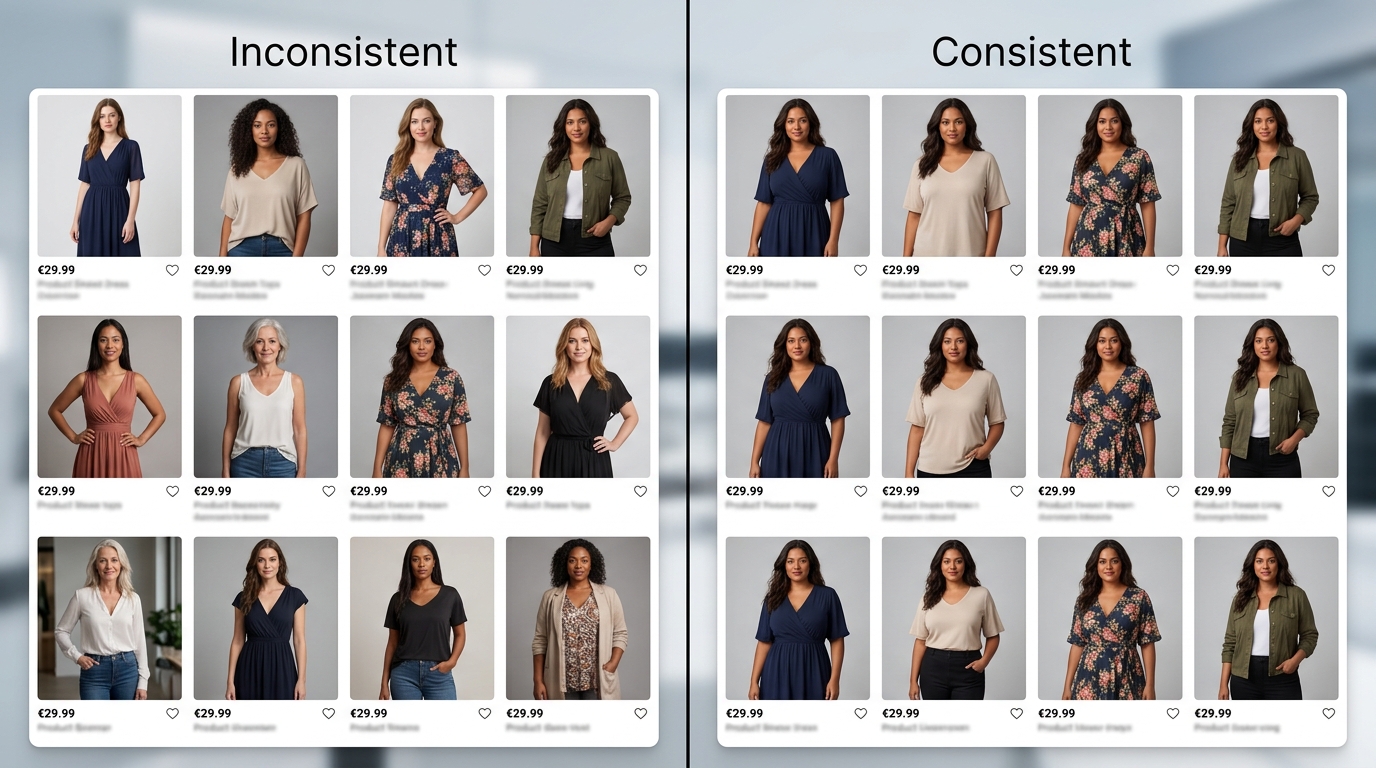
Understanding the Core Challenge: From Single Images to Catalog Production
One-off AI image generation tools are optimized for novelty, not repeatability. They excel at creating a striking image in isolation. However, a production system for catalog imagery requires a different set of controls. The primary goal shifts from "does this image look good?" to "does this image look like it belongs with the other 99 in the collection?"
Without a system designed for consistency, several failure modes emerge. The table below compares the output of a one-off generator with a controlled production system.
| Attribute | One-Off AI Generator | Controlled Production System |
|---|---|---|
| Model Identity | Drifts between images; facial features and proportions change. | Locked and consistent across all images. |
| Styling | Inconsistent hair, makeup, and accessories. | Follows a defined style guide with presets. |
| Lighting | Varies, creating a disjointed look on a category page. | Consistent, controlled lighting setup. |
| Garment Fidelity | Can misinterpret fabric, fit, and color. | High-fidelity rendering from a source product image. |
| Scalability | Each image is a separate creative effort. | Designed for batch processing of entire catalogs. |
Pinpointing Common Failure Modes in AI Model Generation
When consistency is not actively managed, several predictable issues arise that can undermine the quality of an entire catalog. These are not just minor aesthetic glitches; they are commercial liabilities that can confuse customers and weaken brand perception. Understanding these failure modes is the first step toward preventing them.
- Identity Drift: This is the most common and jarring failure. The model's facial features—eye shape, nose, jawline—subtly shift from one image to the next. The shopper may not be able to articulate what's wrong, but they will sense that they are looking at different people, which breaks the illusion of a cohesive collection.
- Body Drift: Proportions can also become inconsistent. A model may appear taller or to have a different build across various SKUs. This is particularly problematic as it makes it difficult for customers to accurately judge the fit and scale of the garments.
- Inconsistent Skin Tone: Without controlled lighting and color correction, a model's skin tone can vary significantly between images. This not only looks unprofessional but can also misrepresent how a garment's color appears on different skin tones.
- Mismatched Lighting: When lighting is not standardized, products within the same collection can look like they were photographed on different days, in different locations. This creates a disjointed and amateurish feel on a category page.
- Styling Chaos: Inconsistent hair, makeup, and accessories create visual noise and distract from the products. A brand's styling should be a deliberate choice, not a random outcome of an unconstrained AI.
- Product Distortion: The AI can sometimes "hallucinate" details on a garment, altering its color, print, or even its basic construction. This is a critical failure, as it amounts to false advertising.
A Practical Workflow for Consistent AI On-Model Imagery
Creating a consistent cast of AI models requires a structured, repeatable workflow. This is not about finding the perfect prompt; it's about building a system of constraints that guides the AI to produce predictable results at scale. Here’s a five-step process that moves from creative direction to scalable production, ensuring your on-model imagery is both compelling and consistent.
Step 1: Define Your Model Personas
Before generating any images, create a detailed written specification for each model you need. A well-defined persona is the foundation of consistency. This document should be treated like a casting brief for a real-world photoshoot, and should include:
- Physical Attributes: Age range, ethnicity, hair color and style, build, and key facial characteristics. Be specific. "A 25-year-old model of East Asian descent with shoulder-length black hair and a confident, direct gaze" is better than "an Asian model."
- Brand Alignment: A one-sentence description of the model's expression and attitude (e.g., "Confident and approachable, with a relaxed, natural expression"). This ensures the model's vibe matches your brand's personality.
- Reference Anchor: Generate a high-quality, front-facing, neutrally-lit image that serves as the "anchor" for this persona. This single image becomes the visual source of truth for all future generations of this model.
Step 2: Lock the Identity and Control the Pose
Use the anchor image as a reference for all subsequent generations. Advanced systems can "lock" a model's identity, ensuring the face and body remain constant. Once the identity is fixed, you can apply it to different poses. This allows for visual variety (e.g., walking, standing, ¾ view) without losing the core model identity. Pose control is essential for creating a dynamic but consistent product grid, and for showcasing different aspects of the garment.
Step 3: Systematize Styling and Backgrounds
Define presets for styling elements to maintain brand consistency. This includes standardizing hair and makeup looks, accessory choices, and background environments. For example, all products in a "Summer Dresses" collection might use a "beachside cafe" background with consistent "natural, sun-kissed" makeup. This prevents the styling from drifting and reinforces the collection's narrative. A study by Vogue Business found that 55% of consumers are more likely to buy a product if it's shown in a context that resonates with their lifestyle.
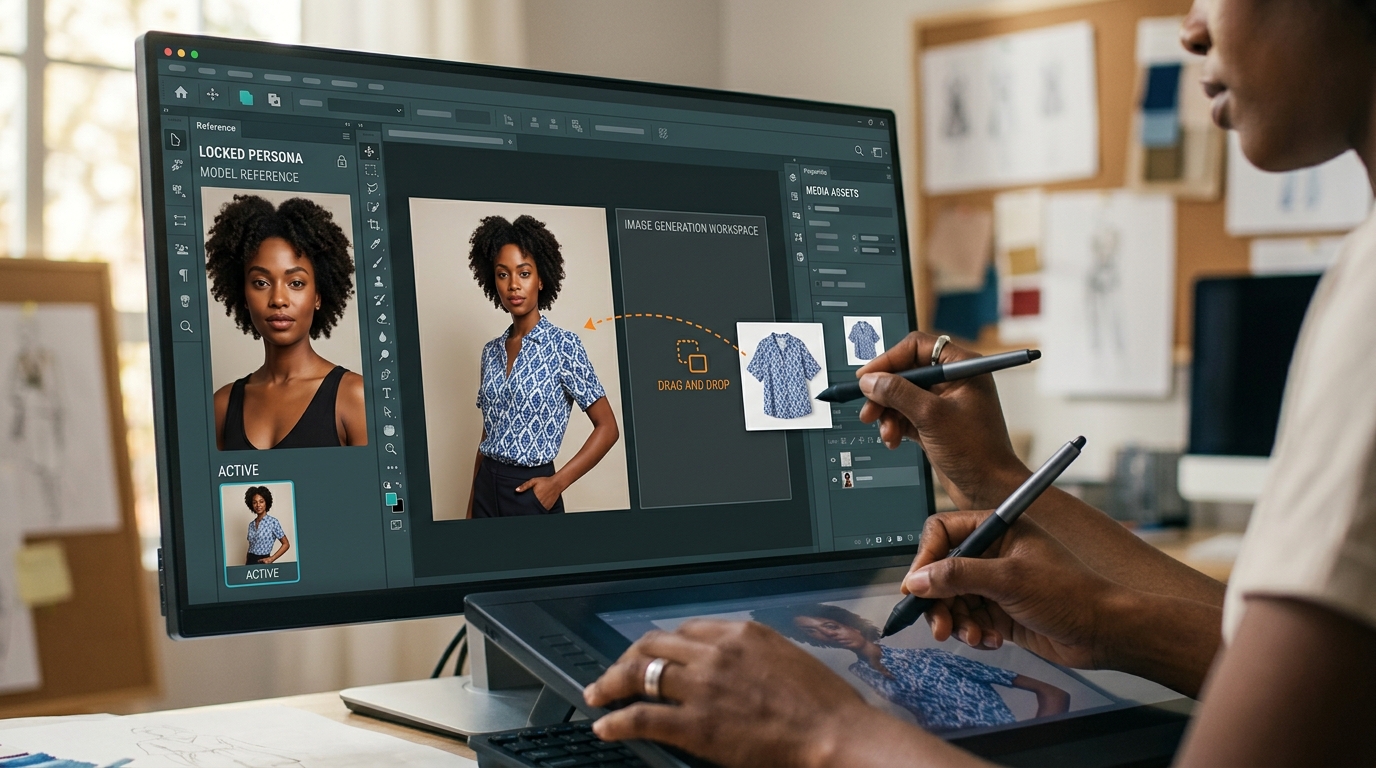
Step 4: Ensure Garment Fidelity
The most critical step is accurately representing the physical product. Model consistency only works when garment fidelity is locked — the AI system must render the garment's true color, texture, silhouette, and fit from a source product image (a flat-lay or packshot). This ensures the on-model image is a faithful representation of what the customer will receive. The goal is to place a real product onto a consistent virtual model, not to create a fictional garment. This is where the quality of your source product photography becomes paramount.
Step 5: Implement a Quality Control (QC) Loop
Even with a controlled system, a human review stage is essential. Establish a clear QC checklist for your team to evaluate each generated image against the model persona, styling guide, and garment accuracy requirements. This feedback loop helps refine the system and catch any deviations before they go live. This stage should be treated with the same rigor as a final check on a physical photoshoot's contact sheet.
How FlixStock Enables Catalog-Scale Consistency
FlixStock is designed as a visual content engine for fashion, moving beyond single-image generation to provide a scalable production solution. The platform addresses the consistency challenge directly by allowing brands to create and reuse model personas across their entire catalog. You define a model once, save it, and can apply that same identity to hundreds or thousands of SKUs.
The workflow is built for production efficiency. By combining a locked model identity with precise garment rendering from your existing product flats, FlixStock ensures that every on-model image is both brand-consistent and product-accurate. This turns the unpredictable nature of generative AI into a reliable, scalable content creation process. For a closer look at how this works, you can explore an interactive demo at zalando-demo.flixstock.com.
Exploring the Business Case for Consistency: ROI and Brand Value
While the aesthetic benefits of a consistent catalog are clear, the business case is equally compelling. Investing in a system for consistent AI model generation is not merely a creative decision; it's a strategic one with a measurable return on investment (ROI). The primary ROI drivers are cost savings, increased conversion rates, and enhanced brand equity.
Traditional photoshoots are expensive and time-consuming. Costs include model fees, photographer fees, studio rental, styling, and post-production. For a large catalog with hundreds of SKUs, these costs can be astronomical. A consistent AI model system dramatically reduces these expenses. Once a model persona is created, it can be reused indefinitely at a marginal cost per image. This allows brands to create on-model imagery for their entire product line, including long-tail items that would not have justified the cost of a traditional shoot.
Increased conversion is another key component of the ROI. As established, consistent, high-quality imagery builds trust and helps customers make more confident purchasing decisions. A visually coherent catalog reduces friction in the shopping experience, which can lead to higher conversion rates and average order values. While specific uplift will vary, the principle is well-established: a better customer experience drives better commercial outcomes.
Finally, brand equity is a less tangible but equally important return. A consistent visual identity across all touchpoints strengthens brand recall and perception. It positions the brand as professional, detail-oriented, and trustworthy. In a crowded market, a strong, consistent brand is a significant competitive advantage. The investment in a consistent AI model system is, therefore, an investment in the long-term health and value of the brand.
What Is the Future of AI in Fashion Imagery?
The evolution of AI in fashion imagery is moving beyond static, on-model photos. The same principles of consistency are now being applied to more dynamic and personalized forms of content. Imagine a customer being able to select a model that most closely resembles them to see how a garment would fit. Or, consider virtual try-on experiences that use a consistent, high-fidelity avatar of the customer themselves.
Furthermore, AI-driven video content is becoming increasingly accessible. A consistent AI model could be animated to create short AI product videos for fashion PDPs, social media content, and even personalized video messages for customers. This opens up a new frontier for engaging and immersive ecommerce experiences, all while maintaining the brand's core visual identity.
The underlying technology is also becoming more sophisticated. AI models are getting better at understanding the nuances of fabric, drape, and fit. They are also becoming more adept at capturing the subtle expressions and micro-expressions that make a model feel human and relatable. As these capabilities continue to improve, the line between real and AI-generated fashion imagery will become increasingly blurred, making a systematic, brand-aligned approach to this technology more important than ever.
Implementing a Technical Framework for Consistency
Beyond the strategic workflow, a technical framework is necessary to enforce consistency at the point of generation. This framework consists of three key components: a centralized model library, version-controlled styling presets, and an API-driven generation process. This is how brands move from ad-hoc image creation to a systematic, scalable content factory.
A centralized model library is the cornerstone of this framework. Instead of defining a model in a text prompt for each generation, brands create a library of pre-approved model personas. Each persona is stored as a unique identifier or a reference object. When a new on-model image is needed, the system calls the model by its ID, ensuring that the exact same identity is used every time. This eliminates the possibility of identity drift and ensures that all images of a particular model are truly consistent.
Version-controlled styling presets work in a similar way. Instead of describing the styling in a prompt, brands create a set of named styling presets that can be applied to any model. For example, a "Fall/Winter 2026 Campaign" preset might include a specific set of hair, makeup, and lighting configurations. These presets are version-controlled, so any updates are tracked and can be rolled back if necessary. This ensures that styling remains consistent across a collection and over time.
Finally, an API-driven generation process ties everything together. Instead of a manual process where a designer enters prompts into a user interface, the generation process is automated. A script or application makes an API call to the generation engine, passing the model ID, the styling preset ID, and the source product image. This removes the variability of manual prompt engineering and ensures that every image is generated according to the brand's exact specifications. This level of automation is what enables true catalog-scale production.