
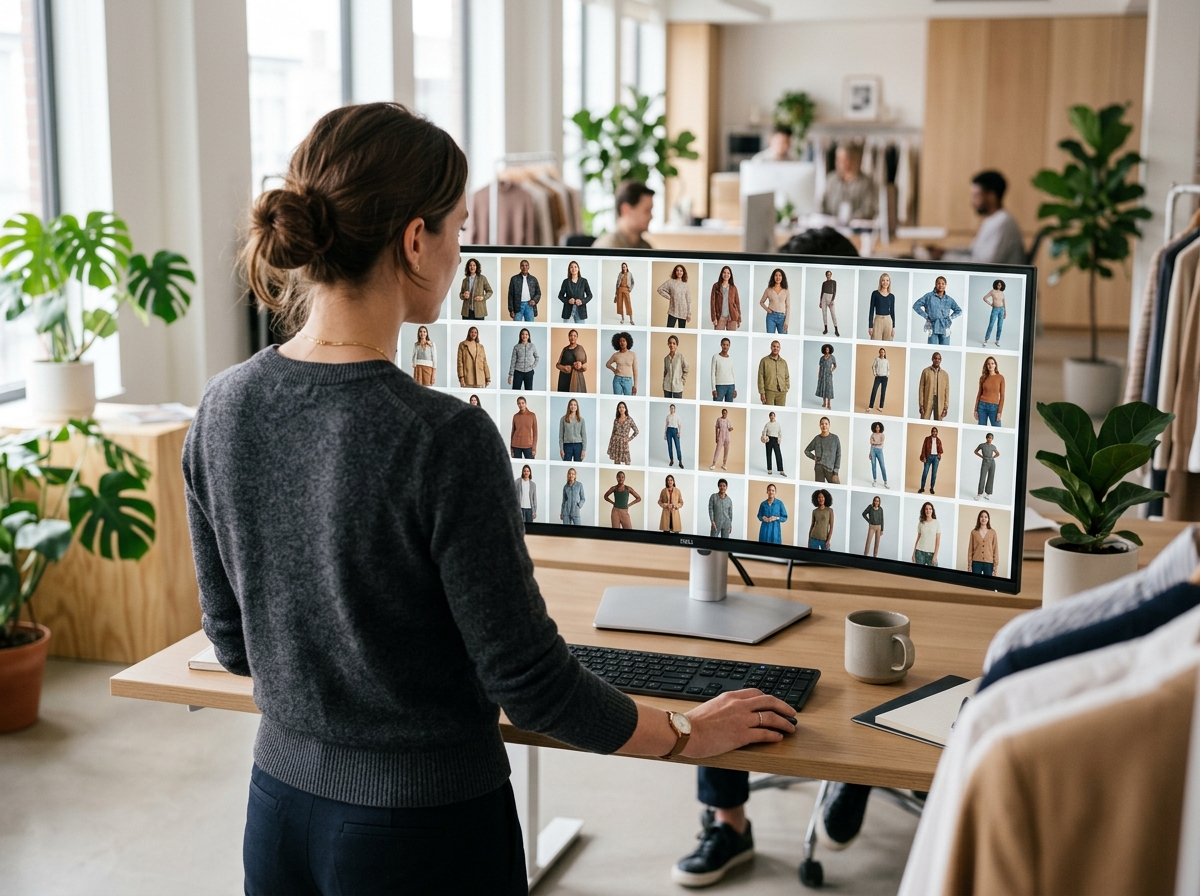
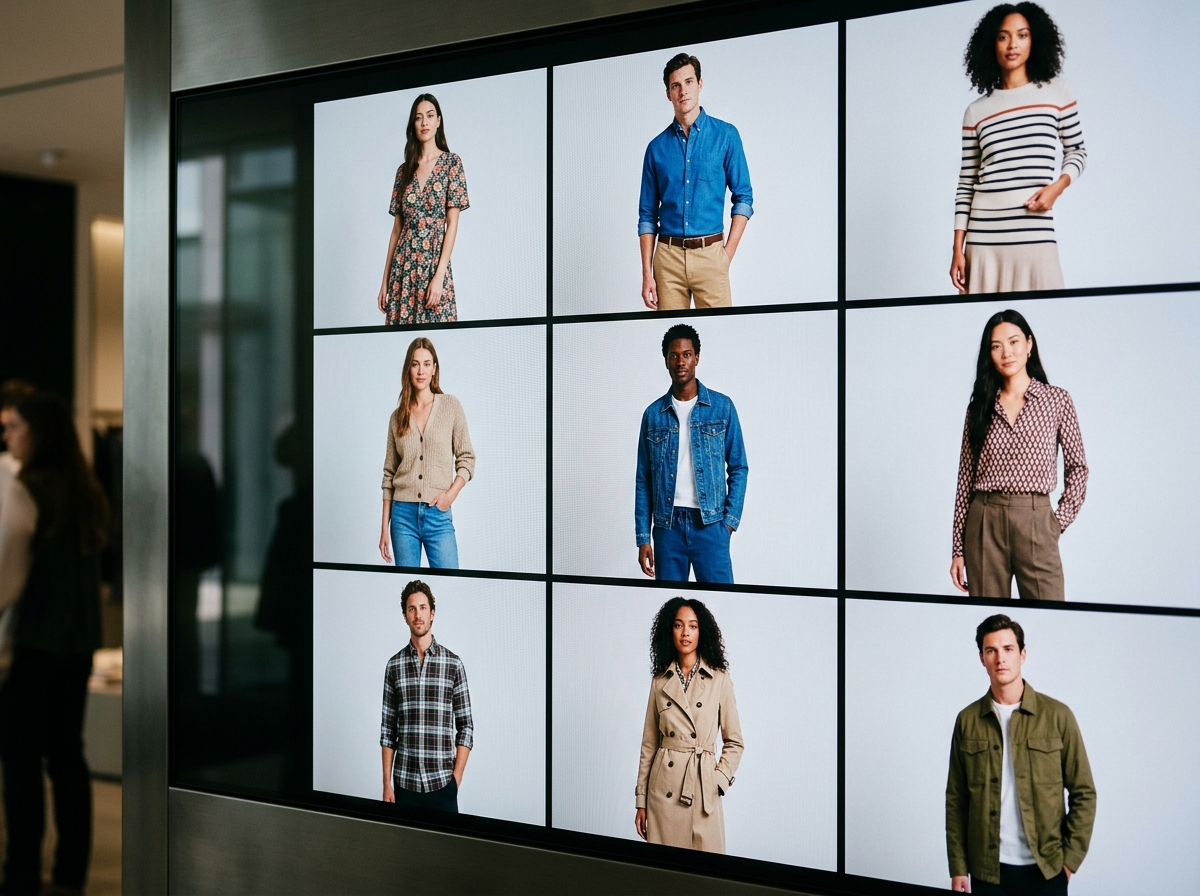
This article details a scalable strategy for creating on-model imagery for your entire product catalog, not just hero SKUs. It’s for catalog managers and e-commerce leaders who need to solve the costly bottleneck of traditional photoshoots and the poor conversion of flat-lay images on long-tail products.
- Understand the limitations of a "hero SKU" photography strategy.
- Learn how automated on-model imagery provides crucial fit and drape cues.
- Implement a four-step playbook for integrating virtual model photography.
- Explore how to cover every SKU in your catalog with FlixStock's platform.
How do you provide a consistent, high-quality shopping experience when 90% of your products are shown as flat lays? For most fashion brands, the cost and complexity of traditional photoshoots mean only top-selling "hero" items get on-model shots, while the rest of the catalog fails to show customers essential details like fit and drape. According to industry analysis, providing clearer visual information about fit and drape is a primary function of emerging AI imagery solutions (Stylitics, 2025).
How a "Hero SKU" Strategy Leaves 90% of Your Catalog Behind
The "hero SKU" approach is a pragmatic compromise, not a strategy. It focuses resources on the 10% of products that generate the most revenue, leaving the vast "long tail" of the catalog with basic, uninspiring packshots. This creates a jarringly inconsistent user experience. A shopper browsing from a beautifully styled hero product to a flat-lay secondary item experiences a drop in quality that signals a drop in merchandising priority. This inconsistency breaks trust and makes it impossible for shoppers to judge the fit, texture, and drape of the overwhelming majority of your products, contributing to an online apparel return rate of 24.4% (Coresight Research, 2023).
What is the Real Bottleneck in On-Model Photoshoots?
The unit economics of traditional photoshoots make scaling them across an entire catalog impossible. A single on-model shoot requires coordinating models, photographers, stylists, studio space, and post-production teams, with individual styled shots ranging from $150 to over $500 per image (Lars Miller Media, 2026). The logistics become exponentially more complex when trying to represent diverse markets or seasonal styles, requiring different models and styling for each variation. The core problem is that the process is manual and linear, and doesn't scale with the speed of modern e-commerce.
| Component | Traditional Photoshoot Workflow | Automated Imagery Workflow |
|---|---|---|
| Asset Required | Physical product sample | High-quality flat-lay photo |
| Time to Market | 2-4 weeks | 24-48 hours |
| Cost per Image | $150 - $500+ | $10 - $30 |
| Scalability | Low (Linear effort per SKU) | High (Parallel processing of catalog) |
| Variation Capability | Requires full reshoot | Infinite variations (models, backgrounds) |
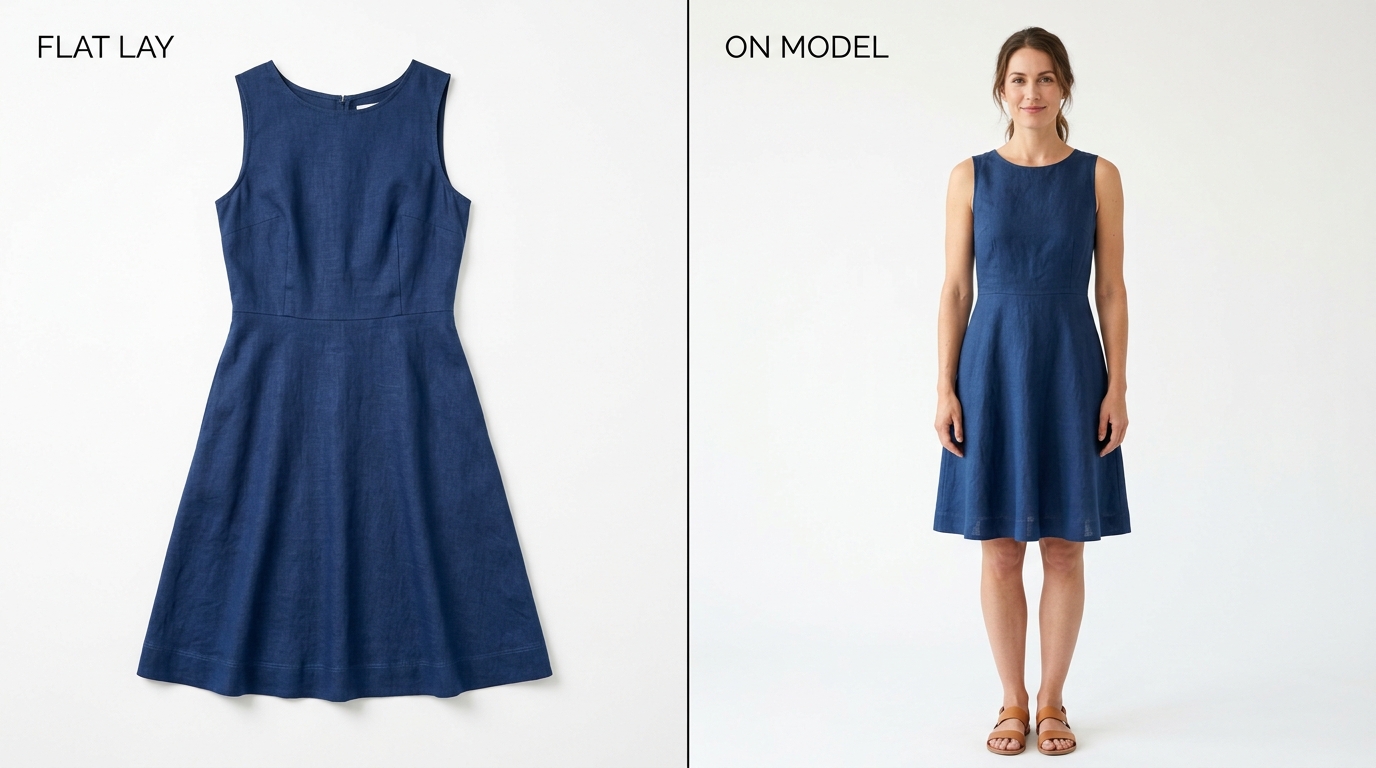
Can AI-Generated Models Provide Fit and Drape Cues at Scale?
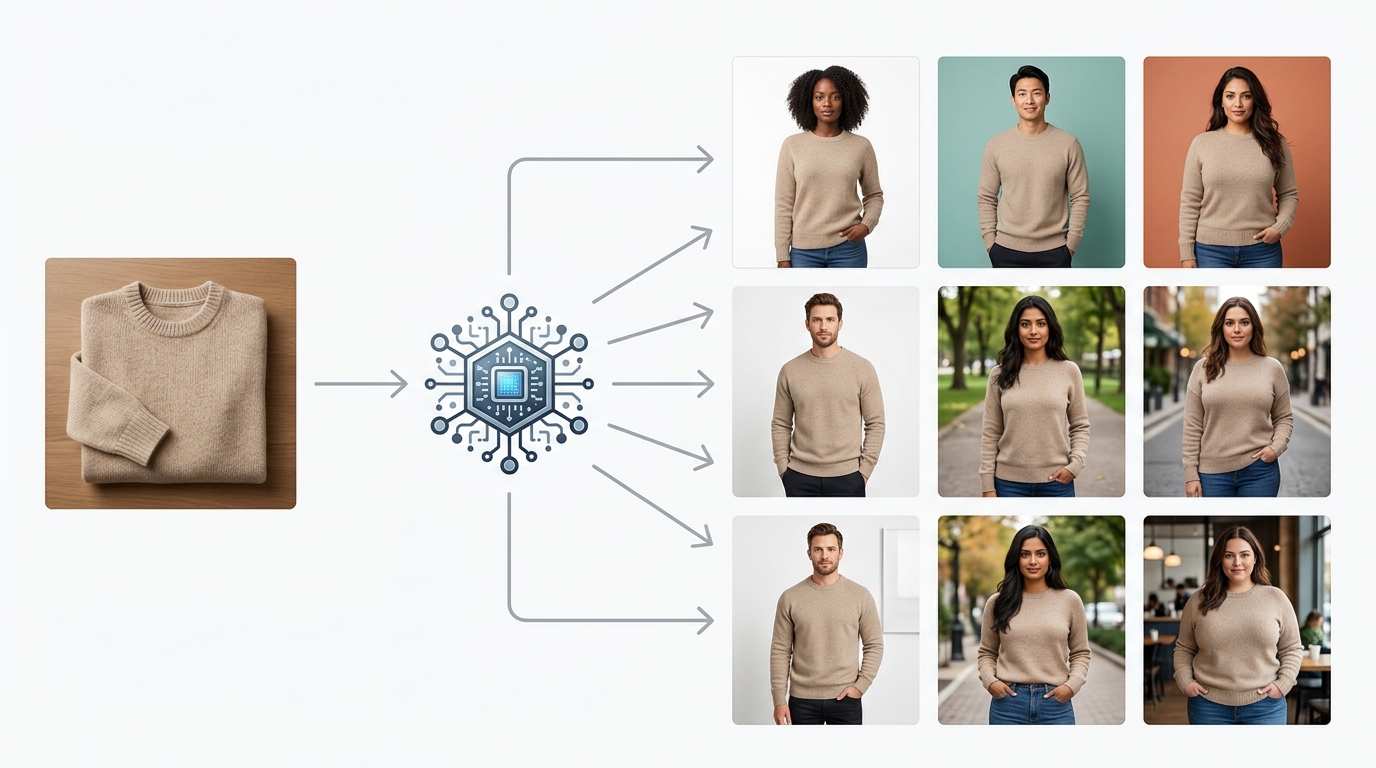
Automated on-model imagery breaks the linear, costly cycle of photoshoots. By using a single flat-lay product photo as a source, AI platforms can generate an infinite variety of on-model visuals. This technology intelligently understands the garment's shape and texture, realistically draping it onto a virtual model. This process allows for the creation of on-model images for every single product in a catalog, including all colorways and variations, at a fraction of the time and cost. Crucially, as highlighted in implementation guides, while AI complements traditional photography, it's essential that the source image provides clear details on texture, seams, and closures to ensure a high-fidelity output (Tolstoy, 2026). The result is a consistent, high-quality visual experience across the entire PDP landscape.
A 4-Step Playbook for Integrating Automated On-Model Imagery
Adopting AI-generated imagery is not just about technology; it's a workflow transformation. A successful integration requires a structured approach to maintain brand standards and product accuracy.
- Establish Your Source of Truth: Start with high-quality, color-accurate flat-lay images for each product. These are the foundation. A reference showing only the front of a garment doesn’t establish how the back or sides should look.
- Define Your Styling and Model Guidelines: Create a clear brief for your brand's aesthetic. Specify the types of models (ethnicity, age), poses, and backgrounds that align with your brand identity. This ensures consistency across all generated images.
- Implement a Fidelity Gate: Human review is critical. As experts at Tolstoy note, "a realistic-looking image can still have the wrong logo, material, or construction." Create a checkpoint to ensure every generated image accurately represents the product's color, texture, and key details before it goes live.
- Measure and Iterate: Track key metrics. Compare the conversion rates, add-to-cart rates, and return rates for products with AI-generated on-model images against those with traditional flat lays. Use this data to refine your styling guidelines and prove the ROI.
How FlixStock Automates On-Model Imagery for the Entire Catalog
FlixStock's platform is designed to execute this playbook at enterprise scale. By uploading a single packshot, catalog managers can generate thousands of on-model images tailored to specific markets, seasons, and customer segments. Our technology ensures that details like fabric texture and drape are rendered with photographic realism. The platform acts as a centralized hub for managing your virtual model and styling guidelines, ensuring brand consistency across your entire product catalog. This finally makes it possible to provide every shopper with the visual information they need to make a confident purchase, for every single item you sell. You can explore a live demonstration of this at our interactive demo site.
What are the KPIs for Scaled PDP Imagery?
Success with automated on-model imagery is measured by its impact on both customer experience and operational efficiency. The primary KPIs to track are on the product detail page: look for a measurable increase in conversion rate and add-to-cart rate, coupled with a decrease in the return rate for products that previously only had flat-lay imagery. Operationally, the key metrics are cost-per-image and time-to-market. Compare the fully-loaded cost of producing an on-model image via AI versus a traditional photoshoot. Likewise, measure the reduction in days from product sample arrival to having a live, on-model image on the PDP. These metrics will demonstrate a clear and compelling return on investment.