

In this article
- Standardizing sRGB color profiles for apparel marketplace listings to prevent visual mismatch.
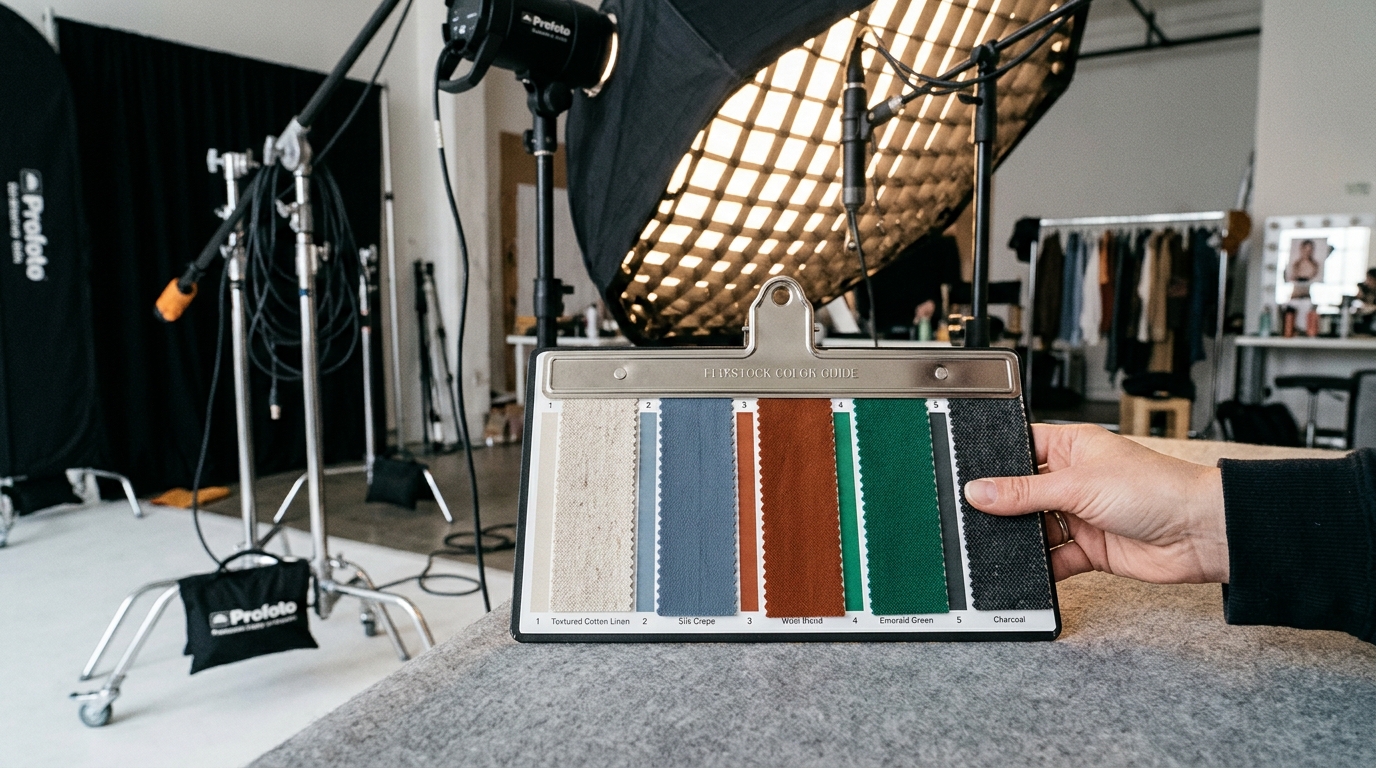
- Controlling studio lighting temperatures and baseline captures for consistent fabric tones.
- Managing Delta E tolerances in post-production to minimize high fashion return rates.
- Leveraging automated visual content engines to preserve true fabric hue across multiple sales channels.
Maintaining garment color accuracy across e-commerce channels is essential for reducing high fashion return rates caused by visual mismatches between product photos and physical deliveries. When studio lighting variations, uncalibrated display profiles, and inconsistent channel exports distort true fabric shades, buyer trust erodes and returns surge. By establishing standardized sRGB color workflows, controlled color temperature baselines, and rigorous Delta E tolerances, fashion catalog managers can ensure consistent garment presentation across every marketplace, PDP, and digital touchpoint.
Why does garment color shift between studio shots and e-commerce listings?
Garment color shifts typically occur due to disjointed capture conditions, inconsistent color management pipelines, and varying consumer display specifications. In traditional studio photography, shifting ambient light sources, strobe bulb aging, and differing fabric dye lots introduce subtle hue variations before post-production even begins. When raw captures are converted without strict profile adherence, color data degrades across disparate retail channels.
Furthermore, many post-production teams rely solely on subjective visual checks rather than quantitative color metrics. This leads to color inconsistency in ecommerce product photos when assets are exported for multiple marketplaces that apply different compression algorithms and color rendering engines. Addressing these discrepancies requires a unified visual supply chain that locks in accurate color capture right from the start. Without structured oversight across every photography session and editing station, color drift accumulates exponentially as assets multiply across channels.
To mitigate these operational challenges, apparel brands must implement strict internal quality assurance guidelines. This includes auditing lighting equipment regularly, enforcing standardized shooting angles, and establishing centralized asset repositories where master color profiles are locked prior to multi-channel distribution. By treating color accuracy as a core supply chain metric rather than an afterthought, merchandising teams protect their margins against preventable product returns.
What color profiles and standards work best for multi-channel fashion catalogs?
To ensure color fidelity across diverse web browsers and retail platforms, the sRGB color profile remains the universal standard for digital apparel listings. Unlike Adobe RGB or ProPhoto RGB—which offer wider gamuts suited for print but often display oversaturated or muted tones on standard consumer monitors—sRGB guarantees predictable color translation across web and mobile devices.
Apparel marketplace listings require strict adherence to platform-specific image compliance rules. When exporting catalog assets, post-production teams must embed sRGB IEC61966-2.1 profiles directly into asset metadata. This prevents color management engines on major sales channels from misinterpreting raw color spaces, ensuring that the exact fabric shade captured in the studio is rendered identically on the customer's screen.
When scaling catalog operations across dozens of global retail partners, maintaining format consistency is equally important. File compression formats like JPEG and WebP must be configured with controlled quality parameters to prevent color banding and artifacting in subtle gradient fabrics such as silk and satin. Establishing a standardized export preset eliminates manual guesswork and ensures every channel receives identical chromatic data.
| Color Profile | Primary Use Case | Web / Mobile Rendering | Marketplace Compliance |
|---|---|---|---|
| sRGB IEC61966-2.1 | Universal e-commerce web & marketplaces | Highly predictable and consistent | Required by Amazon, Zalando, Myntra |
| Adobe RGB (1998) | High-end print and editorial publishing | Oversaturated on unmanaged web browsers | Not recommended for standard web PDPs |
| ProPhoto RGB | Advanced raw image archiving | Clips drastically on standard displays | Incompatible with retail web frontends |

How to test and control Delta E tolerances in fashion post-production
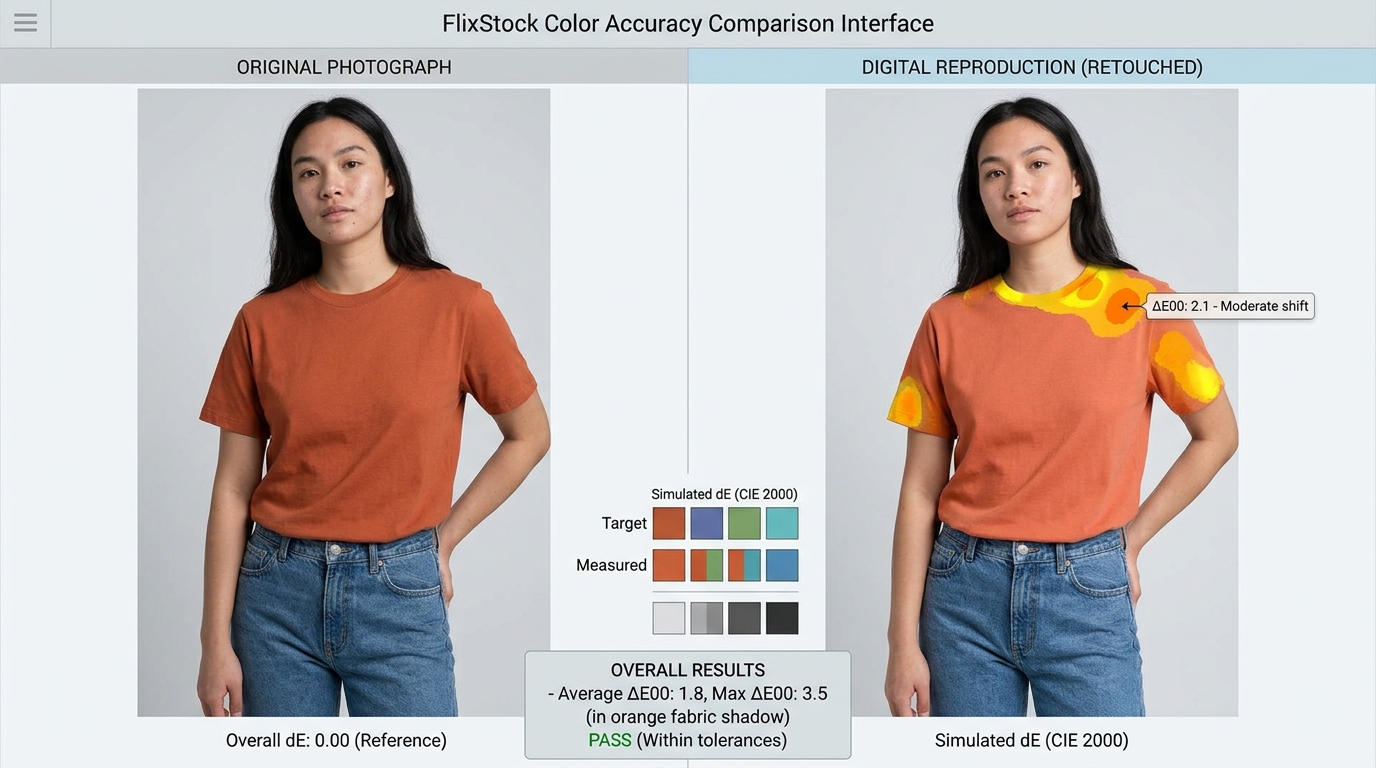
Delta E ($\Delta E$) is the quantitative metric used to measure color difference between the original physical garment and its digital representation. In high-volume fashion e-commerce, maintaining a Delta E threshold below 2.0 is critical for ensuring that color mismatch fashion returns remain minimal. Values above 3.0 are typically noticeable to the human eye, frequently triggering customer dissatisfaction.
Controlling Delta E requires spectrophotometer readings of physical fabric swatches during studio capture, followed by strict calibration during digital retouching. Automated quality control checks compare rendered output against reference color charts to flag out-of-tolerance assets before they reach product detail pages. This systematic verification removes human subjectivity from color correction and guarantees dependable catalog consistency.
Post-production studios must implement regular calibration schedules for all editing monitors, ensuring white points remain locked at D65 (6500K) with a luminance level matching ambient workspace lighting. Without these hardware calibration protocols, human retouchers inadvertently overcompensate for display color casts, introducing new chromatic errors into the catalog pipeline.
Automated post-production workflows preserve true fabric color across variations
Maintaining color integrity across thousands of SKUs and seasonal colorways is exceptionally difficult using manual retouching. Automated post-production workflows utilize color reference tables and machine learning algorithms to apply precise, repeatable corrections across entire catalog batches. By anchoring every asset to verified fabric color profiles, automated systems eliminate batch-to-batch variation.
A common misconception in retail post-production is that monitor brightness calibration alone guarantees accurate product colors across customer screens. While calibrating in-house display monitors is necessary for retouchers, it does not control how end-user devices render lighting and color. True consistency relies on embedding standardized color profiles and utilizing automated color correction for fashion catalog images that compensate for channel-specific compression.
By integrating automated visual engines into the broader enterprise PIM and DAM infrastructure, fashion brands can instantly scale asset creation from a single photoshoot while maintaining flawless color fidelity across all marketing channels.