


This article explains how fashion businesses can use AI to efficiently adapt product images for the varying requirements of multiple e-commerce marketplaces. It is for catalog managers, e-commerce leads, and post-production teams looking to automate image compliance and maintain brand consistency at scale.
- Understand the common image specifications across major online marketplaces.
- Learn how AI automates image adaptation, from aspect ratios to backgrounds.
- Discover the role of a "crop-safe master" image in a multi-channel workflow.
- Implement a system for maintaining brand consistency across all platforms.
Fashion brands struggle to adapt product images for the conflicting specifications of numerous e-commerce marketplaces. The manual rework required to meet diverse requirements for aspect ratios, backgrounds, and dimensions leads to delays and erodes brand consistency across channels. AI-powered systems solve this by automating the entire adaptation process from a single master image.
Why is Platform-Specific Imagery Necessary?
Each e-commerce marketplace and sales channel functions as a distinct digital storefront with its own visual standards and customer expectations. A product image optimized for Amazon’s search results grid will not perform well as a full-screen lifestyle shot on a brand's Shopify store. These platforms enforce specific rules to create a uniform and predictable shopping experience, but this creates significant operational overhead for fashion brands.
The core of the issue lies in the diversity of presentation formats. A square image might be perfect for a grid view, but a vertical "story" format demands a completely different composition. Manually creating and managing these variants for a large catalog is not just inefficient; it's a barrier to scaling. According to industry analysis, brands can spend hundreds of hours per season on image compliance alone, time that could be reallocated to marketing and product development. This manual process is also prone to human error, which can lead to image rejections, further delaying time-to-market for new collections. The opportunity cost of this manual labor is immense, as it prevents skilled creative teams from focusing on higher-value activities like concept development and brand storytelling.
Key differences often include:
- Aspect Ratios: Amazon prefers square (1:1) images for main listings, while others may require portrait (e.g., 2:3) or landscape formats. This single difference can necessitate a complete re-crop of every image, a task that becomes monumental at the scale of thousands of SKUs.
- Backgrounds: Most marketplaces mandate pure white backgrounds (RGB 255, 255, 255) for primary product shots to ensure clarity and consistency. However, a brand's own website might use a signature off-white or light grey background to create a more premium feel. Manually swapping these backgrounds is tedious and requires a skilled editor to achieve a professional result.
- Resolution and File Size: Platforms set minimum and maximum dimension requirements (e.g., 1000px on the longest side) and file size limits to ensure fast load times without sacrificing quality. Juggling these different specifications requires a complex export process and careful file management.
- On-Model vs. Flat Lay: Some channels prioritize on-model photography to show fit, while others may allow ghost mannequin or flat lay images. A brand might need to generate all of these variants to maximize its presence across all relevant channels, a proposition that is often cost-prohibitive with traditional photography.
What Are the Common Image Requirements Across Marketplaces?
While every platform has a detailed style guide, several requirements are nearly universal for primary fashion product images. Meeting these baseline standards is the first step in any multi-channel strategy. A failure to comply can result in listings being suppressed or rejected entirely.
For fashion brands, this means establishing a baseline image quality that can be flexibly adapted. A centralized digital asset management (DAM) system can help, but it doesn't solve the adaptation problem itself. The real challenge is creating the variants in the first place without degrading the quality of the original photograph or violating brand standards. This often involves a delicate balance between automation and manual quality control, a balance that is increasingly shifting towards AI-driven solutions that can be trained on a brand's specific aesthetic. These solutions can analyze an image and intelligently apply the necessary transformations, preserving the integrity of the product while meeting the specific requirements of each channel.
A comparison of major marketplace requirements reveals common patterns:
| Marketplace | Primary Aspect Ratio | Background | Minimum Dimensions |
|---|---|---|---|
| Amazon | 1:1 (Square) | Pure White | 1000px on longest side |
| Shopify | Flexible (often 2:3) | Varies by theme | 800px recommended |
| Zalando | ~1:1.44 (Portrait) | Light Grey or White | 762x1100px |
| ASOS | ~1:1.29 (Portrait) | Off-white/Light Grey | 870x1122px |
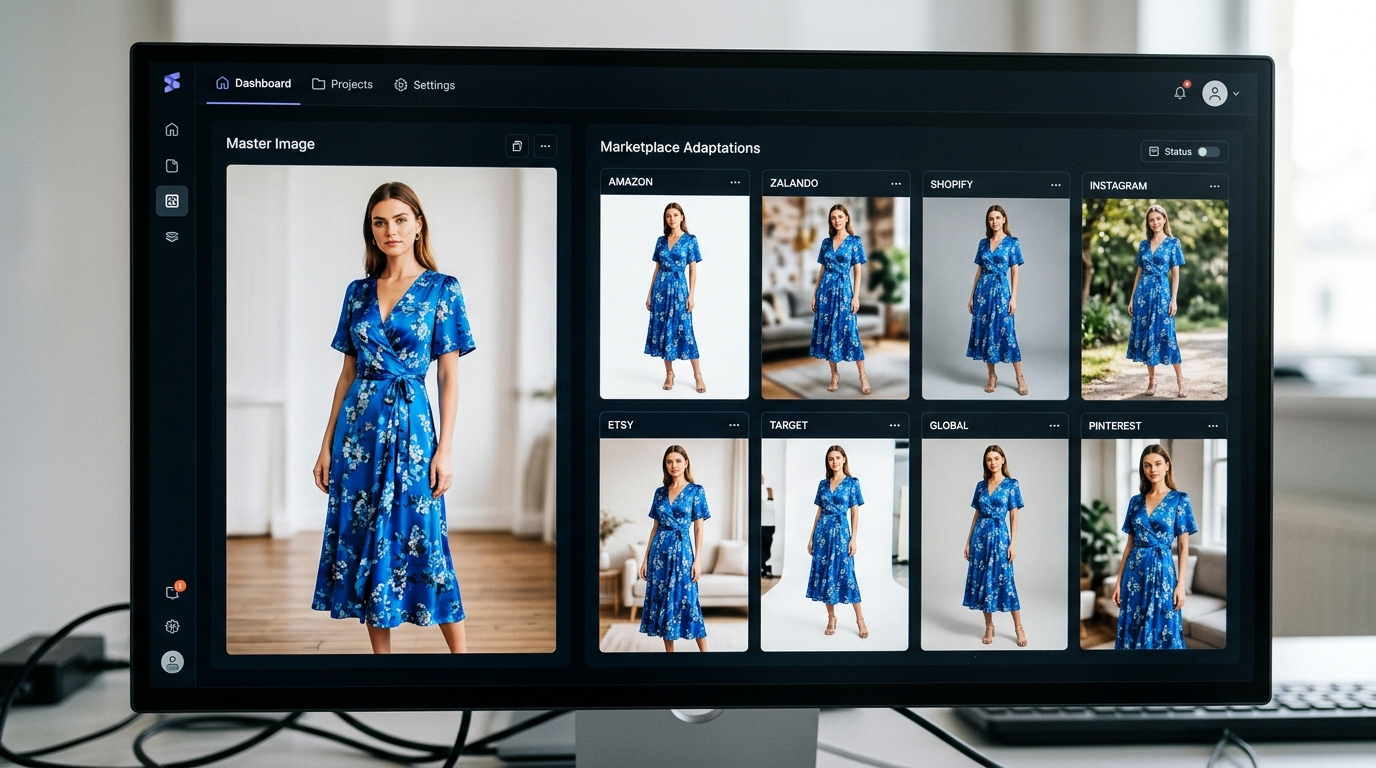
Leveraging AI for Automated Image Adaptation
AI-powered visual content platforms automate the repetitive, time-consuming tasks of image adaptation. Instead of a team of editors manually resizing, cropping, and editing thousands of images, the system ingests a single high-resolution master image and generates compliant variations for every required channel. According to a 2023 report on image transformation, a collection of 500 products with five images each, sold on three marketplaces, requires 7,500 manual adaptations.
This automation is not just about speed; it's about precision and scale. An AI model can be trained on a brand's specific style guide, ensuring that every generated image is perfectly centered, cropped, and color-corrected. This level of consistency is virtually impossible to achieve with a large team of human editors, each with their own subtle biases and interpretations. The system can also learn from performance data, identifying which image styles and compositions lead to higher engagement and conversion on each platform, and then automatically applying those learnings to future image adaptations. This creates a powerful feedback loop that continuously optimizes a brand's visual content for maximum impact.
The AI workflow typically follows four steps:
- Ingest: The system takes in a high-resolution source image, often a "crop-safe master." This can be a simple flat lay, an on-model shot, or even a 3D product render.
- Analyze: AI models identify the subject, background, and key product attributes. This includes not just the product itself, but also details like fabric texture, color, and fit, which can be used to inform the adaptation process.
- Transform: Based on pre-set channel profiles, the system automatically performs background removal or replacement, resizes the canvas, adjusts aspect ratios, and centers the product according to each platform's rules. More advanced systems can even generate entirely new on-model imagery from a flat lay, or swap out the model to better match the target demographic of a specific market.
- Deliver: The platform outputs production-ready files named and organized for each specific marketplace, ready for upload. This can be integrated directly with a brand's PIM or DAM system, creating a seamless end-to-end content pipeline.
The Role of a "Crop-Safe Master" in Multi-Channel Adaptation
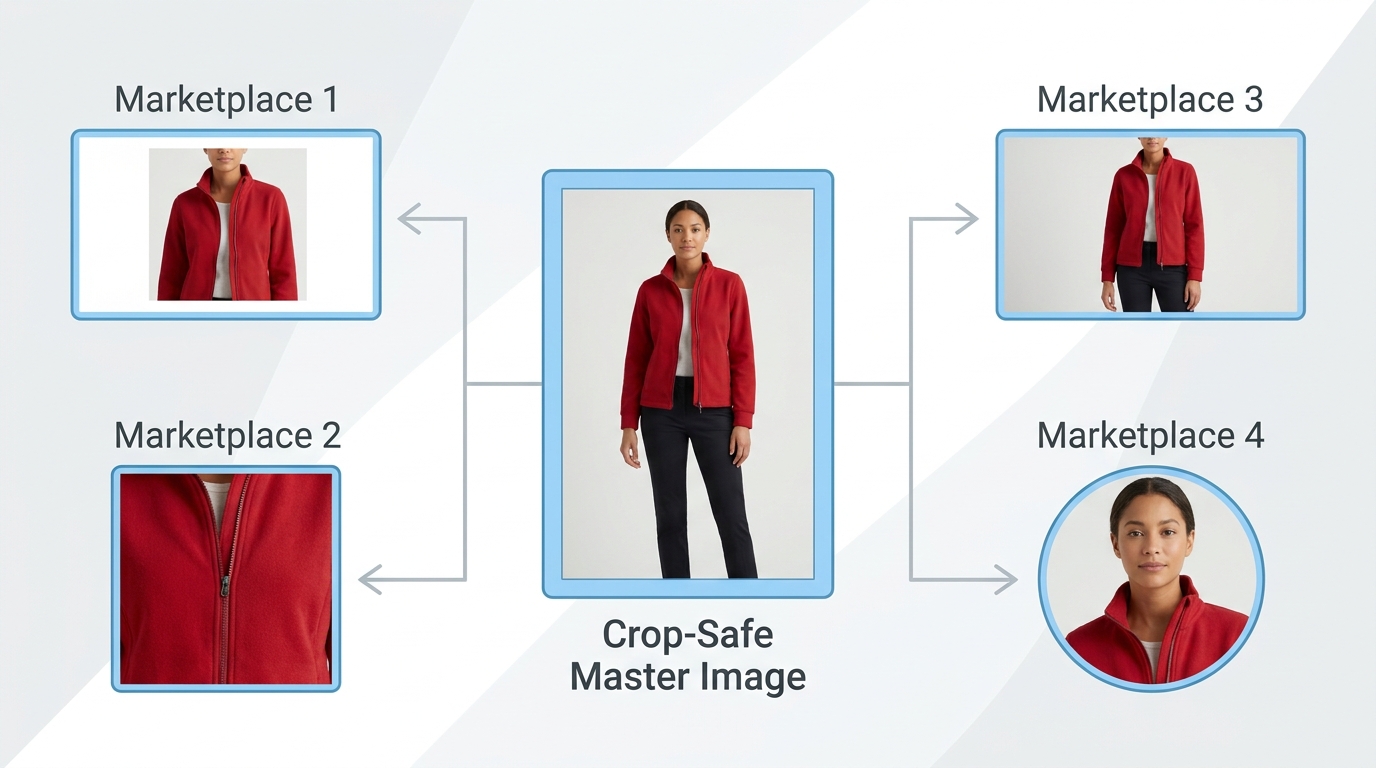
A "crop-safe master" is a high-resolution source photograph shot with enough empty space around the product to accommodate various crops and aspect ratios without cutting off key details. This is a fundamental concept for any brand serious about scaling its visual content across multiple channels efficiently.
Think of it as the raw material for your entire visual catalog. By creating a master image that is larger and more flexible than any single channel requires, you empower an automated system to derive all necessary variants. This "shoot once, publish everywhere" approach is the cornerstone of a modern, scalable visual content strategy. It reduces the need for costly reshoots and allows brands to react quickly to the launch of new sales channels with different image specifications. Furthermore, it future-proofs your content library; when a new marketplace emerges with unique image requirements, you can simply add a new profile to your AI system and generate a complete set of compliant images without having to go back to the studio. This agility is a key competitive advantage in the fast-paced world of e-commerce.
Shooting for a single aspect ratio, like a tight 1:1 square, makes it nearly impossible to generate a 2:3 portrait version later without awkward cropping or adding artificial background. By starting with a master file that includes ample "breathing room," an AI system has the flexibility to generate every required output, from a tight square for a marketplace to a wide banner for an email campaign, all from a single source file.
Maintaining Brand Consistency Across Adapted Images
Maintaining brand consistency is one of the biggest challenges when adapting images for multiple platforms. When manual editing is involved, different editors can introduce subtle variations in lighting, color balance, and cropping, leading to a disjointed customer experience.
A unified visual identity is crucial for building brand trust and recognition. Inconsistent imagery can make a brand appear unprofessional and can confuse customers, potentially leading to a higher bounce rate and lower conversion rate. A shopper should be able to recognize your brand's aesthetic instantly, whether they are on a crowded marketplace or your own curated website. This consistency also extends to the "feel" of the images; lifestyle shots should evoke the same mood, and on-model shots should feature models that represent the brand's target audience, regardless of the platform where they are displayed. Without a centralized system for managing and adapting visual content, maintaining this level of consistency at scale is a near-impossible task.
AI-driven platforms solve this by applying a consistent set of rules to every image. Brand guidelines can be codified into the system, ensuring that every output, regardless of its final destination, adheres to the same standards for model presentation, background color, and product positioning. This ensures that a shopper sees a consistent brand identity whether they discover a product on Amazon, browse it on Zalando, or purchase it from the brand's own website.