
This article provides a cost-comparison framework for fashion brands evaluating traditional photoshoots against AI-powered image production. It is for catalog managers and D2C founders who need to budget for high-volume SKU photography.
- Understand the full cost structure of traditional fashion photoshoots.
- Identify how AI reduces cost-per-image at scale.
- Build a framework to compare photography options for your catalog.
- Develop a cost-effective visual production strategy for your brand.
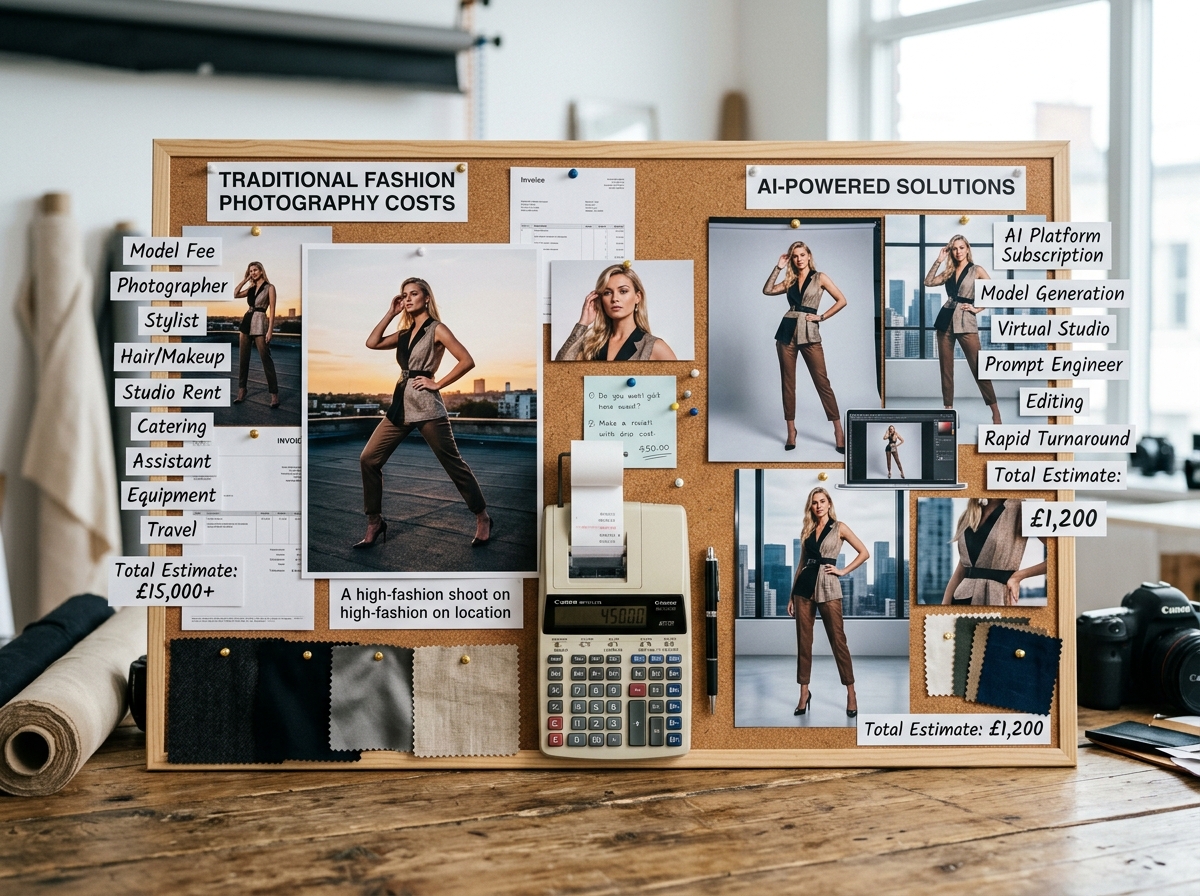
How much should fashion product photography really cost? For brands managing hundreds or thousands of SKUs, the answer is complex. While traditional photoshoots have a familiar line-item budget, their true costs are often hidden in day rates, logistics, and post-production fees that don't scale efficiently. In contrast, AI-powered visual production offers a different economic model, one that decouples cost from volume.
What are the hidden costs of traditional fashion photoshoots?
Budgeting for a traditional photoshoot often starts with a per-image rate, but this figure rarely captures the total investment. Industry guides, such as Shopify's 2026 analysis, place finished image pricing between $50 and $350 per photo, but the expenses that lead to that final asset are far broader. These costs accumulate across three main phases: pre-production, the shoot itself, and post-production.
Pre-production involves significant logistical and creative overhead. This includes model casting, location scouting, stylist and makeup artist bookings, and sample shipping. Each of these components requires coordination and carries its own costs, which are often bundled into a day rate or project fee. A photographer's day rate alone can range from $500 to $3,000, with additional fees for assistants and digital technicians.
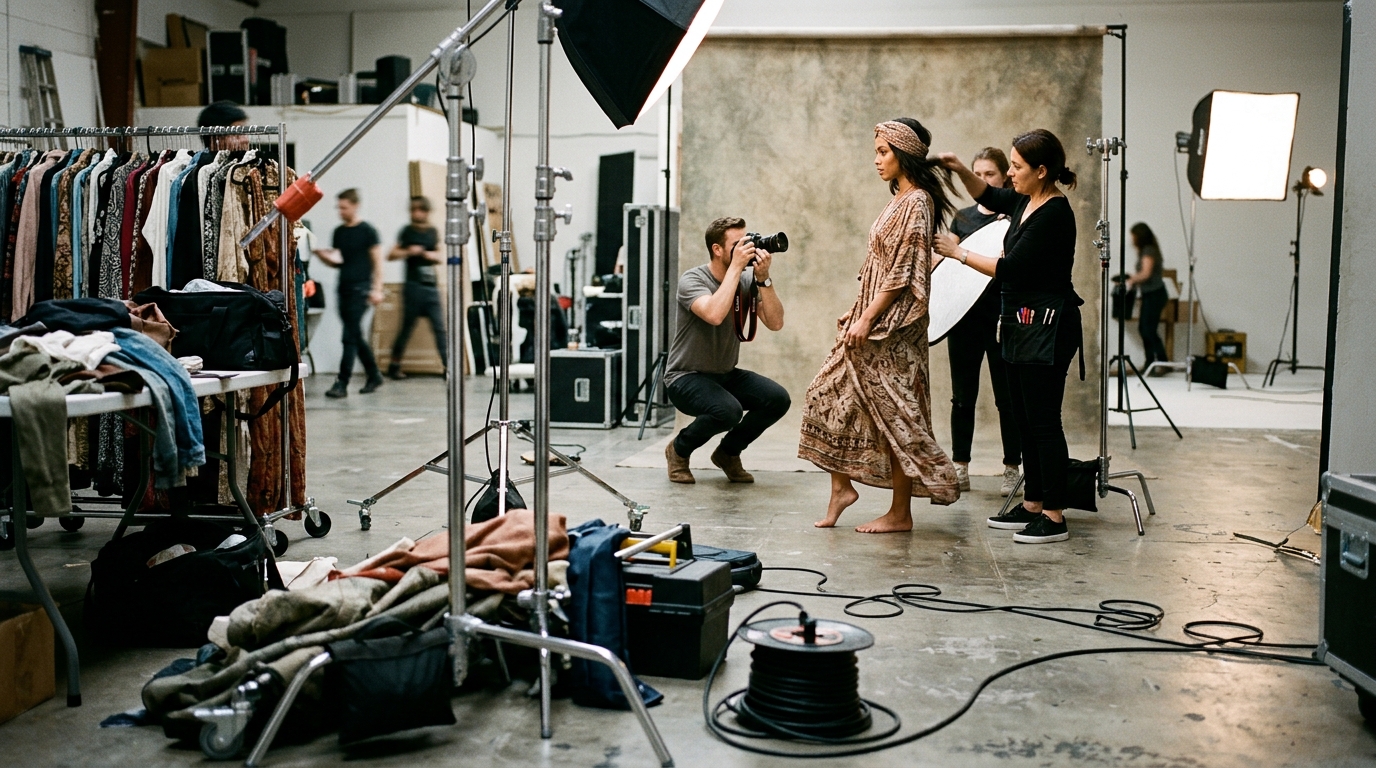
The shoot day itself is where costs are most visible. Studio rental, equipment hire, and crew fees are primary expenses. For a fashion brand, this also includes paying for the time of models, stylists, and makeup artists. Any delays, reshoots, or additional looks not planned for can quickly escalate the budget. Post-production adds another layer, with retouching, color correction, and formatting for different channels often billed separately, sometimes on a per-image or hourly basis.
When these "hidden" costs are factored in, the price per image becomes much higher than the initial quote. This model is particularly inefficient for brands with large, diverse catalogs, where the need for consistency across thousands of images clashes with the high, fixed costs of traditional production.
Why does AI fashion image production reduce costs at scale?
AI-powered visual production fundamentally changes the cost structure of creating fashion imagery. Instead of relying on physical shoots for every variation, AI platforms like FlixStock generate high-quality, on-model images from a single source garment photo. This eliminates the need for most of the expensive, recurring components of traditional photography.
The primary cost saving comes from removing the logistical overhead of photoshoots. With AI, there are no models to book, no studios to rent, and no physical samples to ship for every shot. This dramatically reduces the pre-production and day-of-shoot expenses that inflate traditional budgets. The cost becomes a predictable, per-image fee that is not tied to the complexity of a physical production.
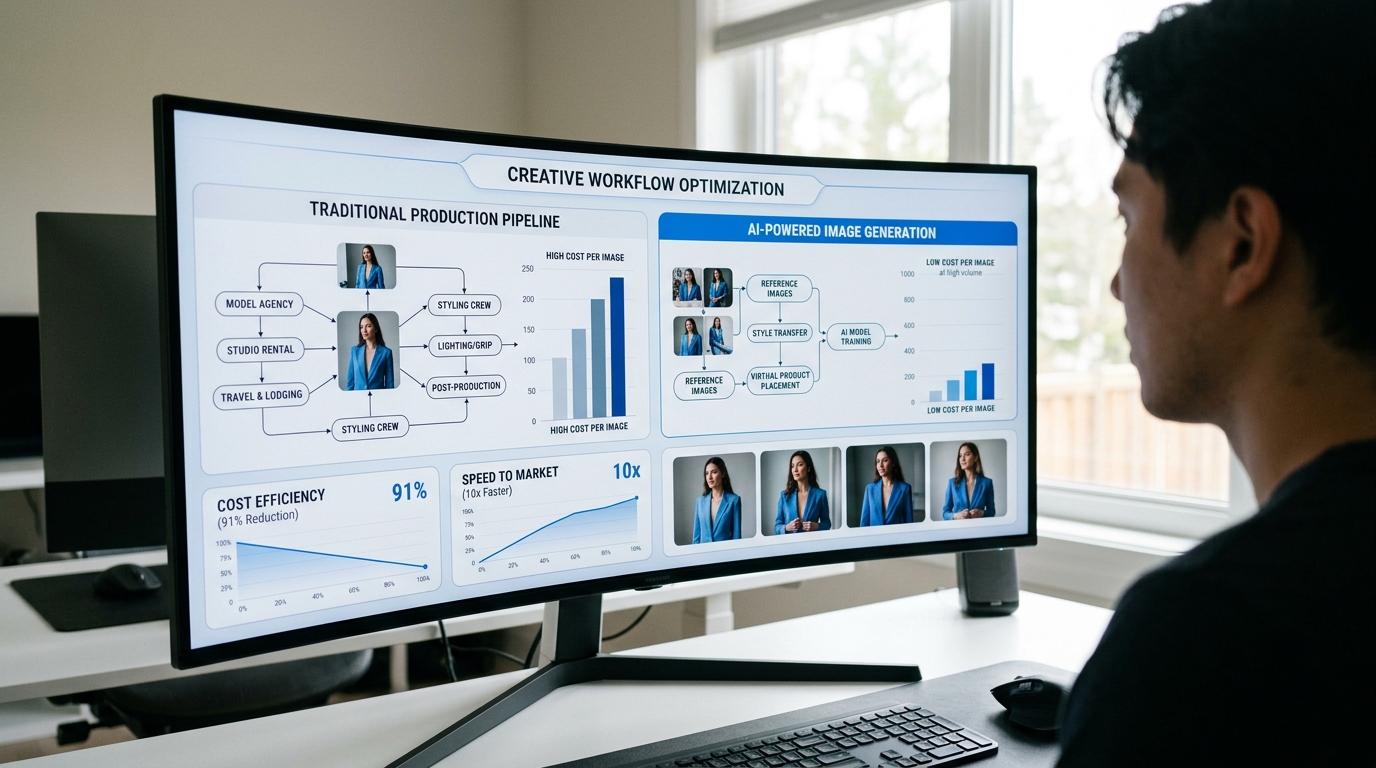
This model is particularly advantageous for large catalogs. A brand can create hundreds of on-model variations—different models, poses, and backgrounds—from one input image without a linear increase in cost. The economics shift from a high fixed cost per shoot day to a low, variable cost per generated image. This allows brands to cover their entire SKU catalog with consistent, high-quality visuals without the prohibitive expense of individual photoshoots for each product.
A Framework for Comparing Per-Image Costs: Traditional vs. AI
A direct "per-image" cost comparison can be misleading without accounting for the total scope of work. A more accurate method is to calculate the Total Cost of Visuals (TCV) for a specific collection or season. This approach provides a clearer picture of the real investment required by each method.
To do this, start by defining the full set of images required. For a single product, this might include on-model shots, a ghost mannequin version, and several detail shots. For a traditional shoot, you would sum all associated costs—from photographer fees to retouching—and divide by the number of final images to get your true cost per image.
| Cost Factor | Traditional Photoshoot (Estimate per Collection) | AI Image Production (Estimate per Collection) |
|---|---|---|
| Photographer & Crew | $2,000 - $10,000+ | $0 (Included in platform fee) |
| Model Fees | $1,000 - $5,000+ | $0 |
| Studio & Equipment | $500 - $2,500+ | $0 |
| Styling & Samples | $1,000 - $4,000+ | $0 (Digital Styling) |
| Post-Production | $50 - $150 per image | Included |
| True Cost per Image (100 SKUs) | $45 - $220+ | Predictable Per-Image Fee |
For AI production, the calculation is simpler. The cost is typically a flat per-image fee that includes the model, background, and styling. By comparing the TCV for both methods, a catalog manager can see how the scalable nature of AI significantly lowers the true cost per image, especially as the number of SKUs and required variations grows.
Exploring the Factors in Your Product Image Budget
Your total visual production budget is influenced by more than just the cost per image. The primary drivers are the size of your catalog, the diversity of your product line, and the number of channels you sell on. Each of these factors multiplies the number of required assets.
A larger SKU count is the most obvious multiplier. However, the need for variations—different model ethnicities, seasonal backgrounds, or channel-specific formats (e.g., marketplace vs. social media)—also expands the total image requirement. Traditional photography handles these variations expensively, often requiring separate shoots. AI, in contrast, can generate these variations from a single source, making it a more budget-friendly solution for brands with diverse market and channel needs.
Building a Cost-Effective Visual Production Strategy
A smart visual strategy blends quality, consistency, and cost-effectiveness. The goal is to create a production workflow that can scale with your business without compromising on brand identity. For many fashion brands, this means adopting a hybrid approach.
Start by identifying your core visual needs. Hero products for a major campaign might still benefit from a full-scale traditional photoshoot to capture unique brand moments. However, for the bulk of your catalog—the hundreds of seasonal SKUs that need clean, consistent on-model imagery—AI production offers a more efficient path. By using AI for standardized catalog shots, you can free up budget and creative resources to focus on high-impact campaign creative, creating a balanced and cost-effective overall strategy.