
This article provides a comprehensive breakdown of how AI visual content engines drastically reduce the high costs of traditional fashion photography. It is written for ecommerce leaders, catalog managers, and studio directors who are tasked with scaling image production on shrinking budgets. You will learn to identify the often-hidden expenses of conventional photoshoots and understand how AI offers a powerful, cost-effective, and scalable alternative for modern fashion brands.
- Understand the true cost drivers behind conventional photoshoots.
- Discover precisely how AI eliminates logistical and resource-heavy tasks.
- Compare the direct and indirect cost-effectiveness of AI versus traditional methods.
- Explore a scalable, on-demand model for visual content production with FlixStock.
Is it truly possible to slash your fashion photography budget without sacrificing the quality or volume of your visual assets? For fashion brands navigating an increasingly competitive market with tightening budgets and escalating content demands, the answer is a definitive yes. AI-powered image production offers a direct and proven path to significant cost savings by fundamentally re-engineering the entire visual content workflow. This technology addresses the core inefficiencies of traditional photoshoots, providing a scalable, agile, and financially sound solution for creating the high-quality visual assets that today's online shoppers demand.
Why are traditional fashion photoshoots so expensive?
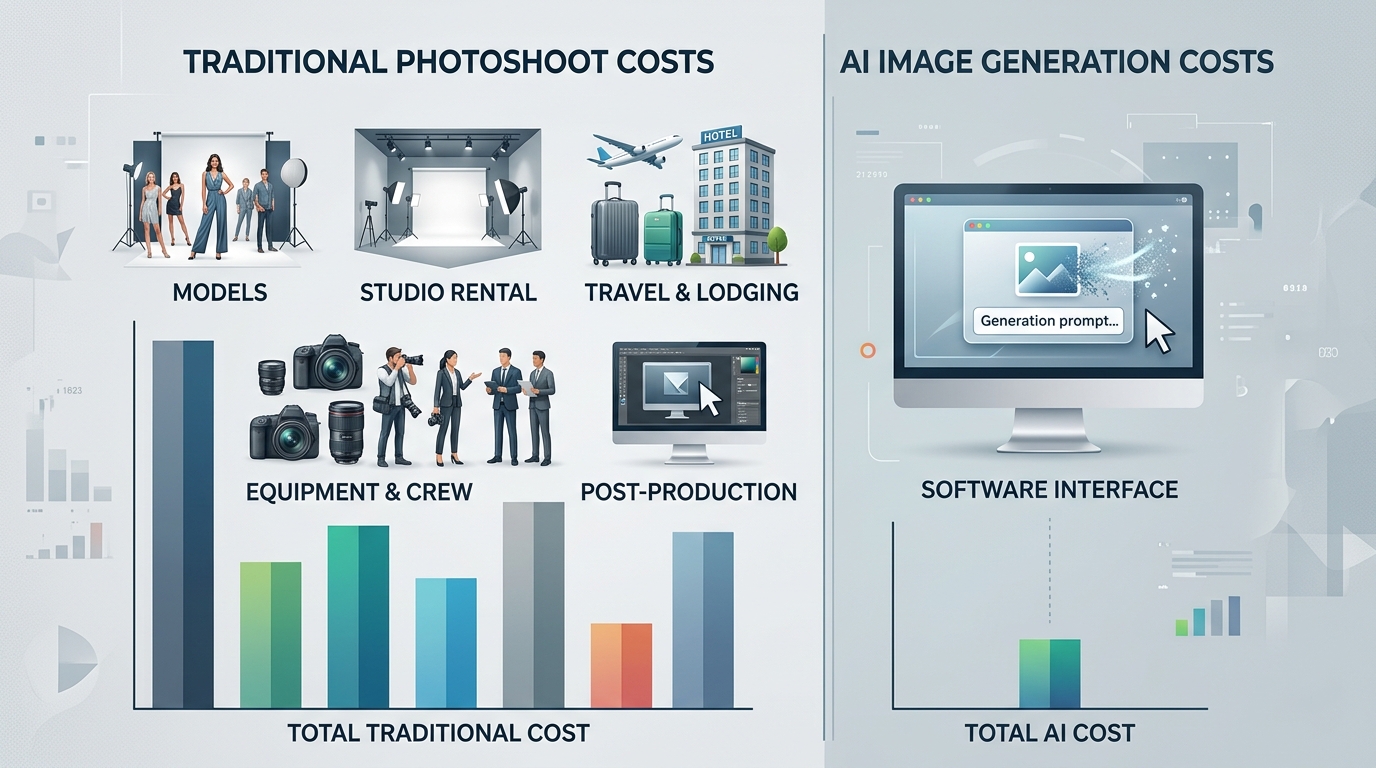
The final invoice for a fashion photoshoot rarely, if ever, captures the full financial impact on a business. Beyond the immediately obvious expenses of photographer day rates and studio rental fees, a significant portion of the budget is quietly consumed by a long and complex list of variable and often-overlooked costs. These "hidden" expenses accumulate rapidly, making it exceptionally difficult to scale content production efficiently, especially for brands with large, diverse, and frequently updated product collections. The entire traditional model is built upon a foundation of manual, time-consuming, and resource-intensive steps that simply do not scale in an economically viable way.
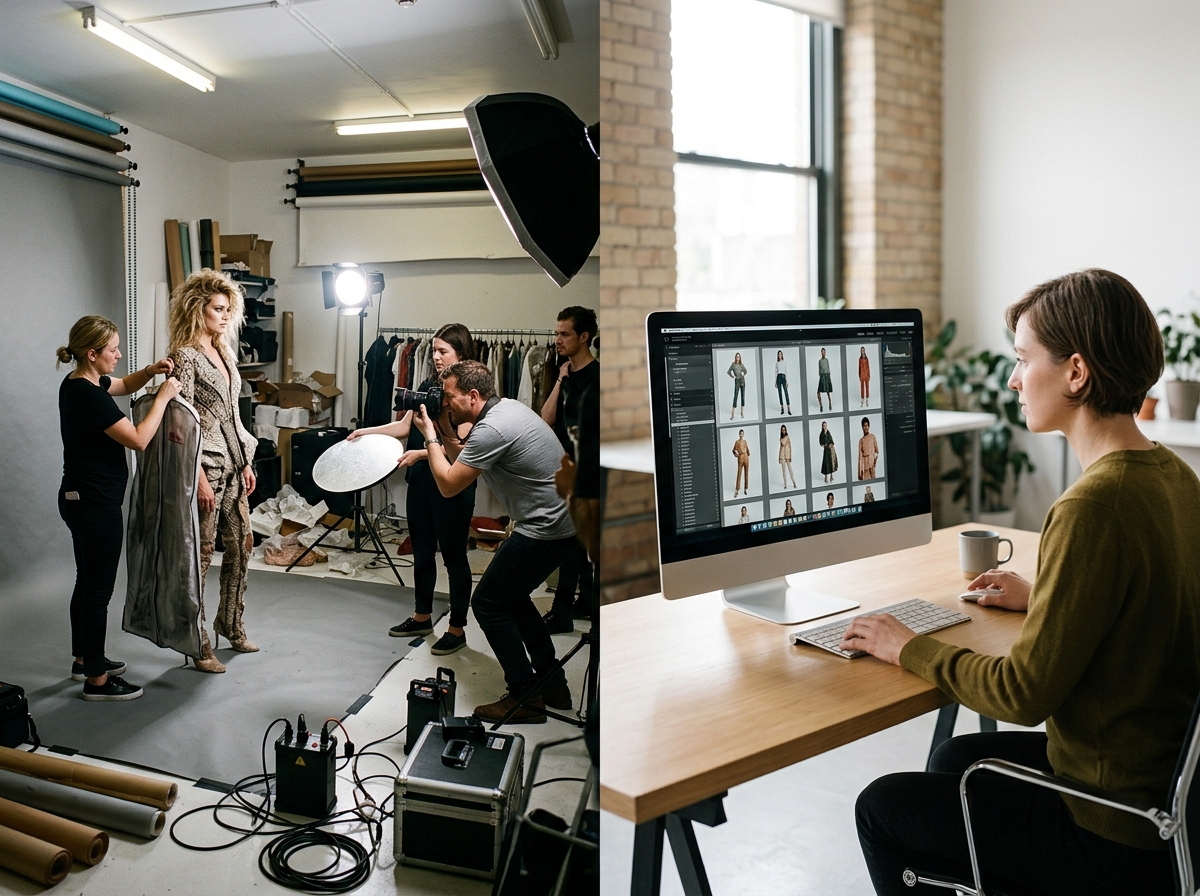
Consider the extensive and costly logistics involved in executing even a single day of shooting. The process of sourcing, casting, and hiring a full creative and production team—including models, stylists, makeup artists, hairstylists, and production assistants—involves not just their non-negotiable day rates but also hefty agency commissions, complex usage rights negotiations, and often-unavoidable overtime pay. The physical logistics of transporting product samples to the studio incur direct courier costs and introduce significant risks of delays, damage, or loss, any of which can disrupt the entire production schedule and lead to expensive, last-minute reshoots. Each of these steps represents not just a line item on an invoice but also a complex, multi-layered coordination effort that consumes invaluable team hours, diverting focus away from more strategic, revenue-generating activities like market analysis and creative strategy development.
Furthermore, post-production represents a major and frequently underestimated cost center. The hours spent on meticulous retouching, complex color correction, and precise formatting of images to meet the specific technical requirements of different e-commerce platforms and social media channels require highly specialized skills and are billed at a premium rate. When a brand needs to produce visual variations for different international markets—requiring models with different ethnic backgrounds and region-specific styling—or for seasonal marketing campaigns, these costs multiply exponentially. Each new look or model often necessitates a completely new shoot or, at the very least, extensive and costly manual editing. This traditional, resource-heavy model inherently ties image production directly to physical assets and manual labor, creating an expensive and inflexible bottleneck that is exceptionally difficult to scale in a fast-moving, hyper-competitive digital marketplace.
How can AI technology systematically reduce key photography expenses?
AI-powered visual content engines are designed to tackle these costs by fundamentally decoupling the process of image creation from the physical and logistical constraints of a traditional photoshoot. Instead of booking models, crews, and studios, brands can leverage sophisticated AI to generate an endless variety of high-quality, photorealistic, on-model imagery from a single, simple product photo—often referred to as a "digital twin" of the garment. This paradigm shift completely changes the cost structure of content production, allowing brands to move from a high fixed-cost, project-based model to a more flexible, predictable, and scalable variable-cost approach that aligns with modern business needs.
Here’s a detailed, step-by-step breakdown of how AI directly eliminates or drastically reduces major expenses across the entire production lifecycle:
- Eradication of Model & Crew Fees: By generating photorealistic models digitally, AI completely eliminates the need to hire human models, photographers, stylists, and makeup artists for the bulk of product shoots. This single change removes one of the most significant and recurring operational expenses from the budget, freeing up substantial capital for other marketing initiatives, product development, or customer acquisition efforts.
- Elimination of Studio & Equipment Rental: With no physical shoot required to generate on-model imagery, the substantial costs associated with renting professional studio space, complex and delicate lighting rigs, and high-end camera equipment are rendered obsolete. High-volume production can happen anytime, anywhere, without the need for a physical location.
- Removal of Sample Shipping & Logistics: Since the entire creative process is managed digitally, brands no longer need to physically ship valuable and often irreplaceable garment samples to a studio. This saves on insured courier costs, eliminates the risk of product damage or loss while in transit, and significantly shortens the overall production timeline from weeks to mere days.
- Automation of Post-Production Hours: Advanced AI platforms automate the most labor-intensive and time-consuming aspects of the post-production workflow. Critical tasks like background removal, blemish retouching, and precise color correction are handled instantly and consistently by the algorithm. The system can generate perfectly formatted, channel-ready images that meet the specific aspect ratios and file requirements of different platforms without the need for extensive and costly manual editing, saving countless hours of specialized labor.
Is AI photography a more affordable long-term option than traditional methods?
Yes, for the vast majority of fashion catalog and ecommerce imagery, AI is not just a little cheaper—it's exponentially more cost-effective and provides a significantly higher and more measurable return on investment (ROI). While a high-concept, aspirational editorial shoot with a world-renowned photographer will always have its important place in high-level brand-building and storytelling, AI excels at producing the high-volume, consistent, and perfectly on-brand product imagery that powers the day-to-day operations of online retail. The cost savings become particularly dramatic and undeniable when brands need to create multiple visual variations of a single product for different markets, platforms, or customer segments—a task that is often prohibitively expensive and logistically nightmarish with traditional methods.
Let's conduct a direct comparison of the two approaches for a common, real-world business scenario: creating on-model images for a single new jacket that is available in five different colorways. These images need to be produced for two different international markets (for example, North America and Japan) which require different model aesthetics and cultural styling cues to be effective.
| Expense Category | Traditional Photoshoot | AI-Powered Production |
|---|---|---|
| Models & Crew (for 2 distinct markets) | Very High (Multiple models, agency fees, potential travel) | None |
| Studio & Equipment | Moderate to High (Full-day rental, insurance) | None |
| Sample Logistics (5 colorways shipped to studio) | Moderate (Insured international shipping) | None |
| Post-Production | Extremely High (Per-image retouching for 20+ final shots) | Low (Automated and included in the platform cost) |
| Scalability & Revisions | Very Low (Requires costly and slow reshoots, linear cost increase) | High (Near-zero marginal cost for each new creative variation) |
The traditional method for this scenario would require multiple days of shooting, complex international logistics, and extensive, detailed post-production, with costs that scale linearly—or even exponentially—with each new requested variation. In contrast, with an AI engine, the incremental cost to generate an additional model, background, or styling variation from the initial product photo is marginal, approaching zero at scale. This allows brands to produce a rich and diverse asset library that can be infinitely adapted and localized, all for a fraction of the cost of a single traditional shoot. As reported by Reuters, major global retailers like Zalando have successfully used this exact approach with AI to cut their image production costs by as much as 90% while simultaneously increasing the speed, relevance, and performance of their visual merchandising.
Beyond initial savings, what are the compounding long-term benefits of an AI visual content engine?
The true financial and strategic value of implementing an AI visual content engine extends far beyond immediate, per-image cost reduction. By creating and institutionalizing a scalable, agile, and highly efficient production workflow, brands unlock powerful strategic advantages that deliver compounding returns over time. The ability to generate market-specific or seasonal content on-demand, without the prohibitive lead time and substantial expense of a new photoshoot, is a significant and sustainable competitive advantage in the fast-paced, trend-driven global fashion industry. This newfound agility allows brands to be far more responsive and strategic in their marketing and merchandising efforts, leading to better business outcomes.
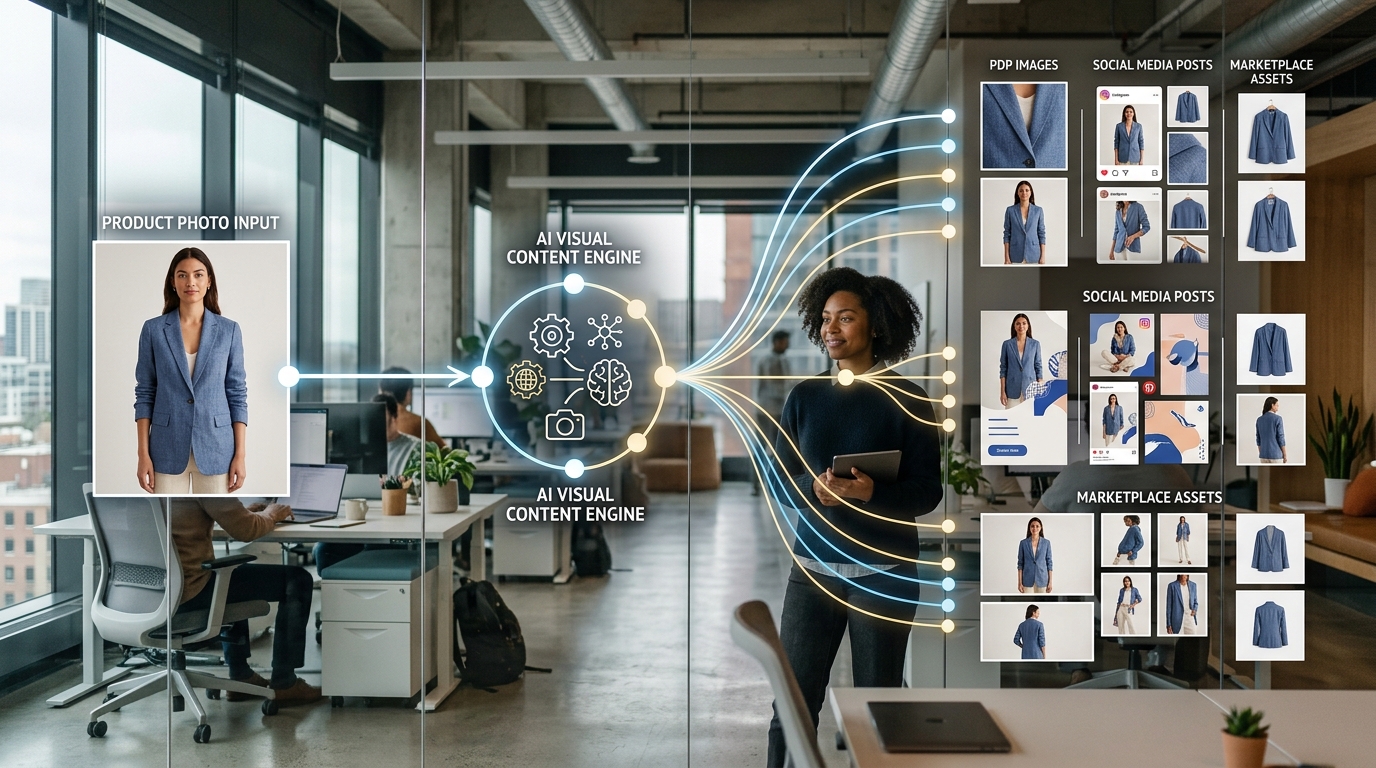
An AI engine like FlixStock functions as a centralized visual supply chain, ensuring absolute brand consistency and quality control across every channel and customer touchpoint. This systemic consistency reduces the need for costly and time-consuming rework and guarantees that all product imagery—from PDPs on your website to posts on social media and listings on third-party marketplaces like Amazon or Zalando—aligns perfectly with your established brand guidelines. Over time, this leads to a more cohesive and trustworthy customer experience, which in turn strengthens brand equity, builds lasting customer loyalty, and can lead to demonstrably higher conversion rates and customer lifetime value.
Furthermore, the unparalleled speed and flexibility of AI allow brands to react almost instantly to market trends, competitor moves, and internal sales data. If a particular style or colorway is performing exceptionally well in a specific region, a full suite of new visual assets can be generated in a matter of hours, not weeks, to support targeted marketing campaigns and maximize those sales opportunities. This newfound agility transforms the visual content team from a reactive, and often siloed, cost center into a proactive, data-informed, and strategic revenue driver. This shift translates directly into increased sales, higher customer engagement, and a significantly improved return on investment for all visual content produced throughout the year.
Finally, how does FlixStock streamline your visual supply chain?
FlixStock provides a complete, end-to-end visual content engine designed specifically for the unique scale and complexity of the modern fashion retail industry. By uploading a single, basic image of a garment—or even just a technical design document (tech pack)—your team can instantly and automatically generate a complete set of photorealistic on-model images, clean ghost mannequin shots, professional packshots, and even dynamic product videos without the immense overhead and logistical complexity of a physical photoshoot. This radically streamlined process not only cuts your production costs but also dramatically accelerates your time-to-market, allowing you to launch new collections and react to emerging trends faster than ever before. Explore the full capabilities of the platform and see how it works with our interactive demo.
Our platform is engineered to handle the complexities of large-scale catalogs, ensuring that every image produced is not only high-quality but also perfectly aligned with your brand's aesthetic. We understand that consistency is key in fashion, and our AI models are trained to maintain the integrity of your products' colors, textures, and fit across thousands of images. This level of precision, combined with the ability to generate limitless variations, empowers your team to create a truly personalized and engaging shopping experience for every customer, in every market. The result is a visual content strategy that is not just cost-effective, but also a powerful driver of sales and brand loyalty.
In addition to cost savings, FlixStock's AI-powered platform offers unparalleled creative control. Brands can experiment with different models, backgrounds, and styling options in real-time, allowing for rapid A/B testing of visual concepts to determine what resonates most with their target audience. This data-driven approach to creative decision-making was previously unattainable due to the high costs of traditional photoshoots. By democratizing access to high-quality visual content creation, FlixStock empowers brands of all sizes to compete on a level playing field, driving innovation and creativity across the industry. This is not just about saving money; it's about unlocking new opportunities for growth and customer engagement in an increasingly visual digital landscape.
Common questions about AI photography costs
How much does AI photography cost?
The cost of AI photography is typically priced on a flexible per-image or subscription basis, making it a variable expense that scales directly with your content needs. This model is demonstrably more cost-effective than the high fixed costs of a traditional photoshoot, as you only pay for the assets you actually produce. As a benchmark, a report by Forbes notes that brands can see cost reductions of up to 90% for certain types of imagery when switching to AI-driven workflows.
Can AI replace all your fashion photoshoots?
While AI is an incredibly powerful tool for producing high-quality catalog and ecommerce imagery at an industrial scale, it's not intended to replace all photoshoots. High-concept brand campaigns, aspirational editorial shoots, and seasonal lookbooks often benefit from the unique creative direction and narrative storytelling of a human team. AI is best utilized to augment and streamline the production of your high-volume product images, freeing up creative teams to focus on high-impact brand marketing.
What types of fashion images can AI produce to save money?
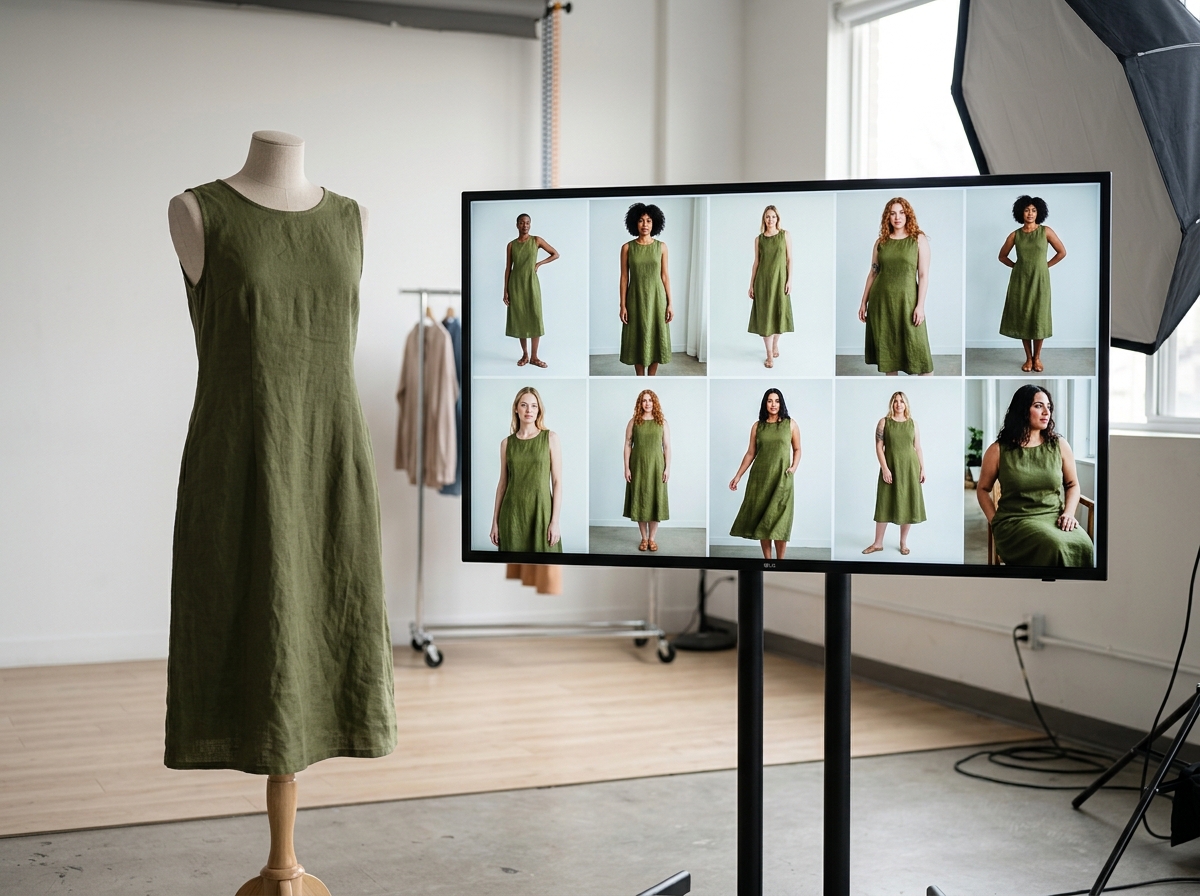
An AI image generation platform can create a wide range of essential fashion images that are costly and time-consuming to produce traditionally. This includes on-model photos featuring a diverse range of models, clean ghost mannequin effects, perfectly lit flat lays, and interactive 360-degree product views. By automating the creation of these core assets, AI helps brands achieve comprehensive visual coverage for their entire catalog while saving significantly on the costs associated with producing each image type individually.
How quickly can AI generate product images compared to traditional methods?
The speed difference is dramatic. AI can generate a full suite of product images in a matter of minutes or hours, compared to the weeks or even months it can take to plan, execute, and complete post-production for a traditional photoshoot. This incredible speed allows brands to get new products live on their site faster, accelerating the sales cycle and enabling a much quicker, data-driven response to emerging market trends.
Why is AI so effective for product photography?
AI is particularly effective for product photography because it automates the most time-consuming, repetitive, and expensive parts of the image creation process. It can generate perfectly consistent and realistic models, create uniform lighting and backgrounds across an entire collection, and produce thousands of image variations from a single input. This is all achieved without the need for a physical studio, a large crew, or extensive manual retouching, making it a highly efficient solution for modern e-commerce.