

- How to spot subtle garment distortions, blurred fabric weaves, and seam misalignments in AI fashion assets.
- A rigorous 5-step QA checklist for high-volume catalog publishing and marketplace compliance.
- Techniques for auditing shadow consistency, drop angles, and skin tone fidelity across multiple model poses.
- Batch sampling strategies to maintain studio quality control without slowing down rapid SKU drops.
Scaling AI fashion photography unlocks unprecedented speed across product pages, but without rigorous fashion catalog image quality control, subtle generation flaws can slip directly onto live product detail pages (PDPs). Catalog managers and studio leads managing thousands of SKUs face the constant challenge of catching blurred fabric textures, misaligned seams, warping around closures, and mismatched drop shadows before assets reach buyers. When defective images bypass review, customer trust erodes and return rates climb. This comprehensive guide outlines a production-proven framework to audit AI-generated apparel imagery, ensuring uncompromised visual accuracy, brand consistency, and marketplace compliance at scale across all retail channels.
As digital asset management evolves, e-commerce brands are moving away from traditional physical photoshoots toward intelligent synthetic pipelines. However, introducing artificial intelligence into apparel production creates new inspection demands. Without structured verification protocols, minor rendering glitches in garment drape or stitch patterns can proliferate across thousands of SKU variations within minutes, highlighting why systematic digital quality assurance is now a core pillar of modern studio operations and enterprise merchandising success.
Furthermore, maintaining high visual standards requires aligning cross-functional teams around clear acceptance criteria. Merchandisers, post-production specialists, and catalog managers must collaborate to establish automated thresholds that evaluate every generated derivative before it populates content management systems or Enterprise Resource Planning (ERP) databases.
What are the most common visual artifacts in AI-generated fashion photos?
Deploying AI to generate on-model apparel, ghost mannequin shots, and marketplace variations eliminates costly physical reshoots, but synthetic image generation introduces specific artifacts that standard automated pipelines frequently miss. Understanding your ai fashion image qa checklist starts with identifying these recurring structural flaws.
The most frequent generation errors include fabric texture smoothing that obliterates fine weave details, unnatural stretching across high-mobility joints like elbows and knees, and subtle seam distortions where synthetic sleeves meet torso panels. Furthermore, inconsistencies in specular highlights across buttons, zippers, and metallic trims often betray artificial generation. Studio leads must establish strict visual tolerance bounds specifically targeted at these failure modes before approving assets for live e-commerce deployment.
Additionally, generative models can occasionally struggle with complex asymmetric closures, buttonhole placement, and pocket alignment. When scaling catalog volume into the tens of thousands of SKUs, human inspection alone cannot keep pace with generation speed. Establishing robust automated and semi-automated gating mechanisms ensures that every asset published to your online storefront meets exacting retail standards without creating operational bottlenecks or delaying seasonal product launches.
How do you inspect seam alignment and fabric weave at 100% zoom?
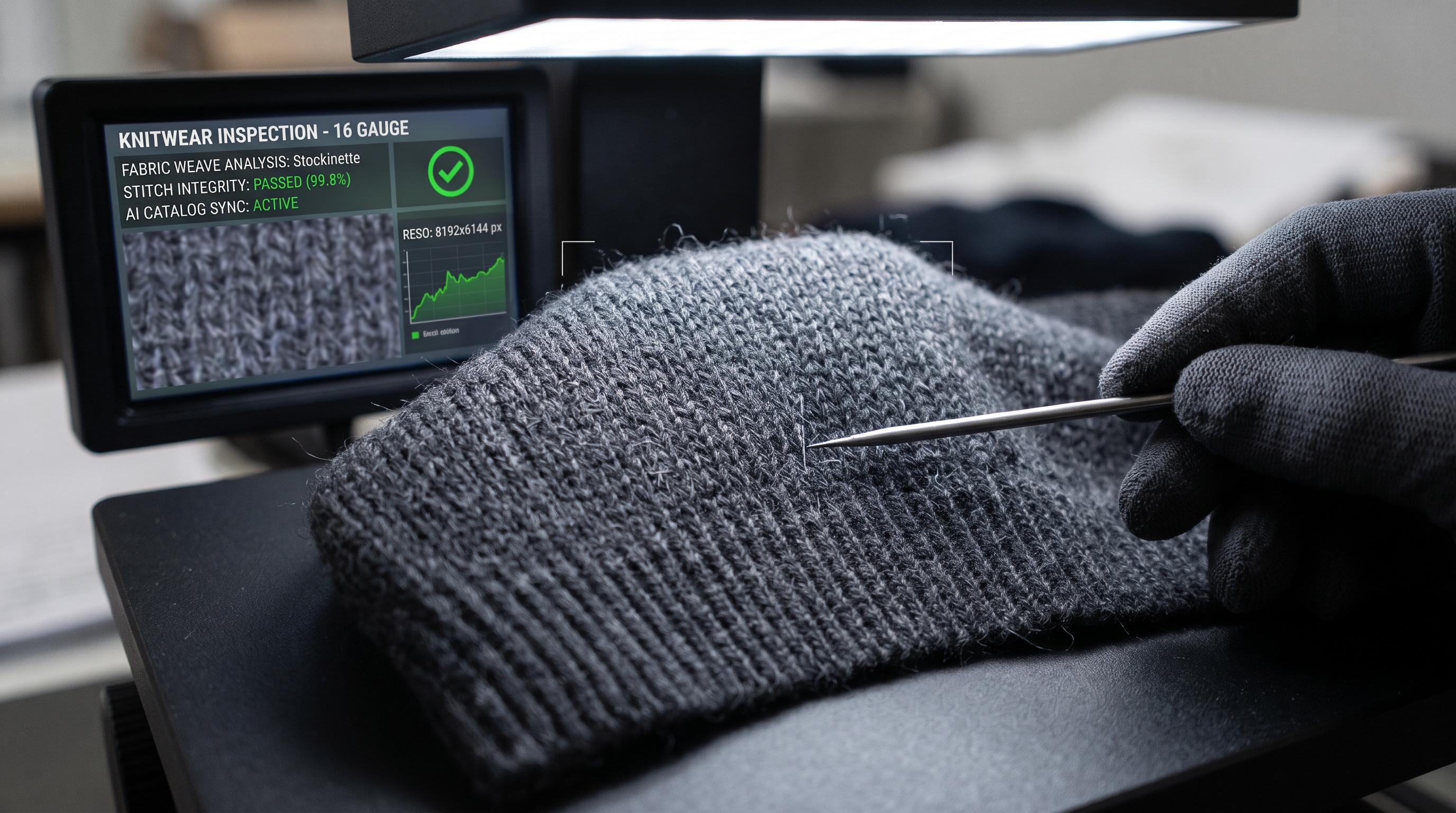
Auditing fine detail requires looking past overall aesthetic appeal and examining structural integrity at 100% pixel zoom. When reviewing garment texture and seam distortion in ai images, quality control operators must isolate critical stress points such as collar ribbing, shoulder seams, button plackets, and hem stitching.
A compliant AI catalog asset must retain the tactile characteristics defined in the original garment tech pack or flat lay reference. If a cotton twill weave appears completely smooth or washed out, or if vertical seams warp sideways under model articulation, the asset fails catalog qa standards. Implementing systematic digital loupe checks ensures that synthetic rendering respects the physical laws of woven and knit textiles.
Furthermore, sheer fabrics, heavy wools, and ribbed knits present distinct rendering challenges. High-resolution inspection protocols must evaluate how light interacts with individual thread structures. By enforcing rigorous 100% crop reviews on hero SKU categories, studio teams prevent textural degradation from reaching premium merchandising displays and influencing shopper perception.
Why does automated quality control outperform manual inspection at scale?
To better understand efficiency gains in studio workflows, consider the following operational comparison between manual auditing and automated pipelines:
| Inspection Method | Speed per SKU | Artifact Detection Rate | Cost per 1,000 SKUs |
|---|---|---|---|
| Manual Pixel Review | 15–20 minutes | 75% (subjective fatigue) | High (labor intensive) |
| Automated AI QA Pipeline | < 5 seconds | 94% (consistent bounds) | Low (automated batch) |
Adopting automated validation tools empowers lean studio teams to scale output without compromising brand integrity or risking marketplace image rejections. Automation eliminates human fatigue during repetitive batch reviews, ensuring consistent quality application across every single category rollout.
When should catalog image QA be integrated into production pipelines?
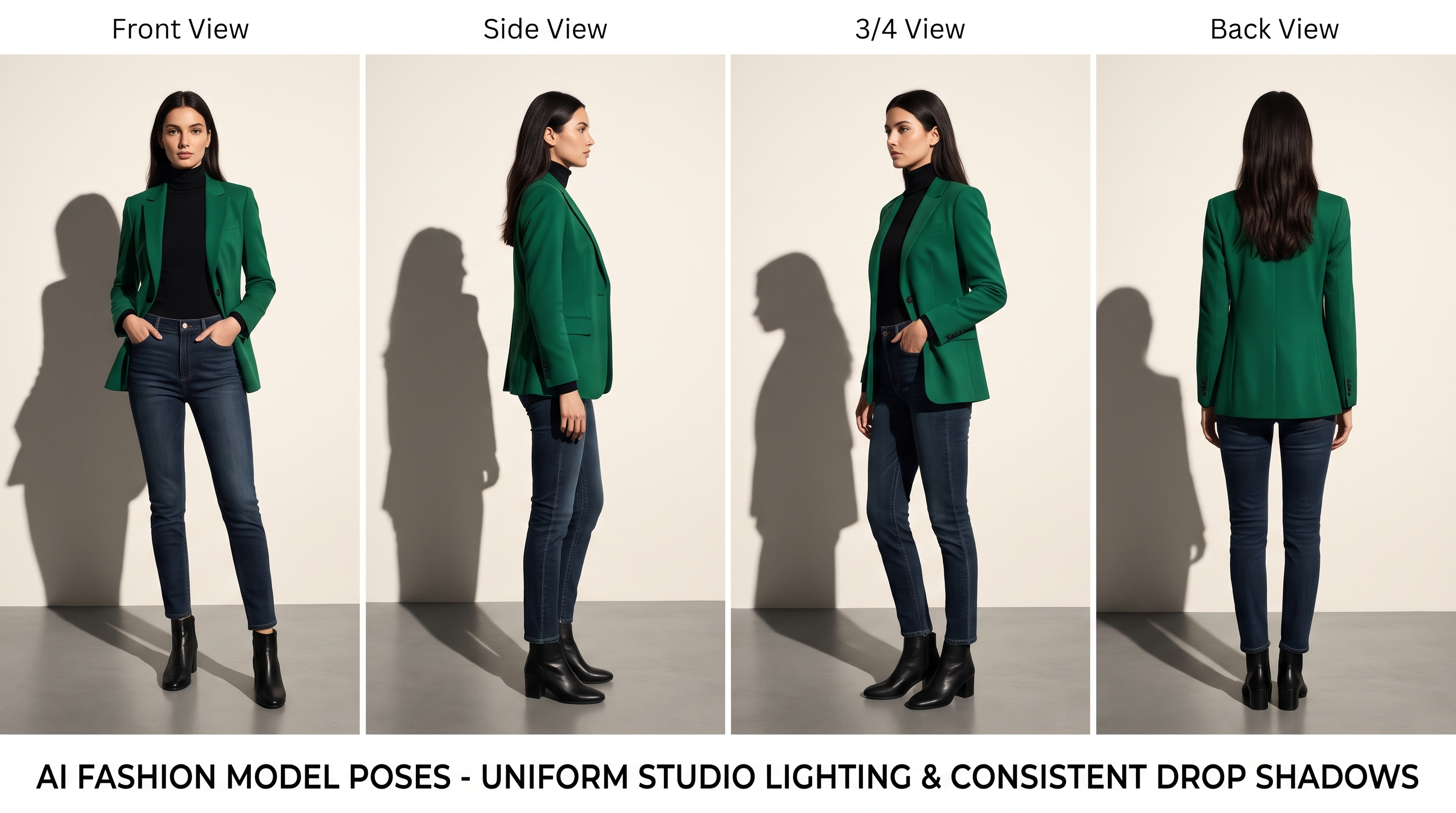
Multi-angle catalog sets and alternate model poses require absolute uniformity in ambient lighting direction, key-to-fill ratios, and drop shadow angles. A common pitfall in high-volume AI production is lighting variance between front, side, and rear views of the exact same SKU.
Checking how to check lighting and skin tone consistency across catalog images involves verifying that the primary light source originates from a consistent focal angle across every pose variant. Specular highlights on skin and fabric must match drop shadow vectors on the studio floor, preventing the jarring visual disconnect that occurs when different poses are generated under disparate synthetic lighting environments.
Integrating quality gates immediately after asset generation and prior to marketplace export prevents defective files from polluting downstream systems. Establishing clear milestones across the visual supply chain guarantees that editorial and commercial assets remain pristine.
Which parameters define marketplace image compliance standards?
Establishing an efficient fashion ecommerce studio quality control workflow prevents bottlenecks while guaranteeing defect-free releases. Studio teams often assume that quality control requires manual pixel-by-pixel inspection of every single catalog derivative, but batch sampling key hero views combined with standardized tolerance bounds catches over 90% of generation artifacts in a fraction of the time.
Here is the proven 5-step checklist for high-volume catalog publishing:
- Tech Pack & Color Match Verification: Compare rendered garment hues against digital color standards (Pantone or ICC profile references) to prevent costly color-matching errors.
- Fabric Texture & Weave Integrity Check: Inspect 100% crops of critical textile areas (lace, ribbing, twill) to ensure zero smoothing or artificial blurring.
- Seam & Closure Alignment Audit: Confirm that buttons, zippers, stitches, and seams follow anatomically correct lines without floating or distortion.
- Lighting & Drop Shadow Uniformity: Validate that key lighting angles and floor shadow vectors match seamlessly across all alternate poses and colorways.
- Marketplace Spec & Format Validation: Run final automated checks for resolution, aspect ratio, and background purity required by individual retail channels.
Executing these five steps systematically ensures complete end-to-end governance over digital apparel assets from initial generation to final multichannel distribution across global retail ecosystems.

Frequently Asked Questions
What is the acceptable color tolerance threshold during catalog visual QA?
Industry-standard e-commerce visual QA typically mandates a Delta E (ΔE) value of less than 2.0 between physical garment color swatches and final digital renders to ensure accurate online representation and reduce customer returns.
How do you audit fine details like lace, sheer fabrics, and thin straps?
Fine details require specialized multi-pass inspection masks at 200% zoom to verify that intricate transparencies, sheer layering, and delicate spaghetti straps maintain clean edge definition without AI artifact bleeding.
Should catalog image QA happen before or after marketplace format export?
Core visual QA for garment fidelity, texture, and lighting must always occur on master high-resolution assets before marketplace cropping, padding, or format export takes place.
How can studio teams automate sample checks for thousand-SKU drops?
Studio teams automate high-volume QA by deploying computer vision scripts that flag anomalies in edge sharpness, color histogram distribution, and bounding box dimensions across batch-processed SKU outputs.
What role does metadata compliance play in image quality control?
Metadata compliance ensures embedded color profiles, C2PA provenance tags, and correct naming conventions travel with the image asset, preventing rejection on major retail channels like Amazon and Zalando.