


This article explains how AI-powered background removal and replacement solves the challenge of inconsistent product imagery for fashion brands. It is for catalog managers and ecommerce leads who need to produce high-quality, consistent visuals at scale, without the high costs of traditional retouching or reshoots.
- Understand the impact of background consistency on brand perception and sales.
- Learn how AI handles complex fashion items like sheer fabrics and fine details.
- Discover how to create diverse lifestyle scenes from a single studio shot.
- Implement a workflow for consistent backgrounds across your entire catalog.
Is manual photo editing creating a bottleneck for your entire fashion catalog? For many brands, the process of removing and replacing backgrounds is a slow, costly, and inconsistent effort that undermines an otherwise professional online presence. AI-powered tools now offer a scalable solution, enabling brands to achieve catalog-wide consistency and quality faster than ever before.
Why do consistent product image backgrounds matter for fashion ecommerce?
In fashion ecommerce, visual consistency is not a luxury; it's a core component of brand identity and customer trust. When a shopper browses a category page, a uniform background creates a clean, professional, and seamless experience. It allows the products—the clothes, shoes, and accessories—to be the hero. Inconsistent backgrounds, with varying shades of white, distracting shadows, or different lighting, create a jarring, unprofessional look that can erode trust before a user even clicks on a product.
This consistency is crucial for both brand-owned sites and third-party marketplaces. A study analyzing listings across multiple categories found that products with high-resolution, professionally produced photos convert at a rate 94% higher than those with low-quality images. While "quality" is multifaceted, a clean and consistent background is a foundational element of a professional shot.
How does AI background removal work for intricate fashion items?
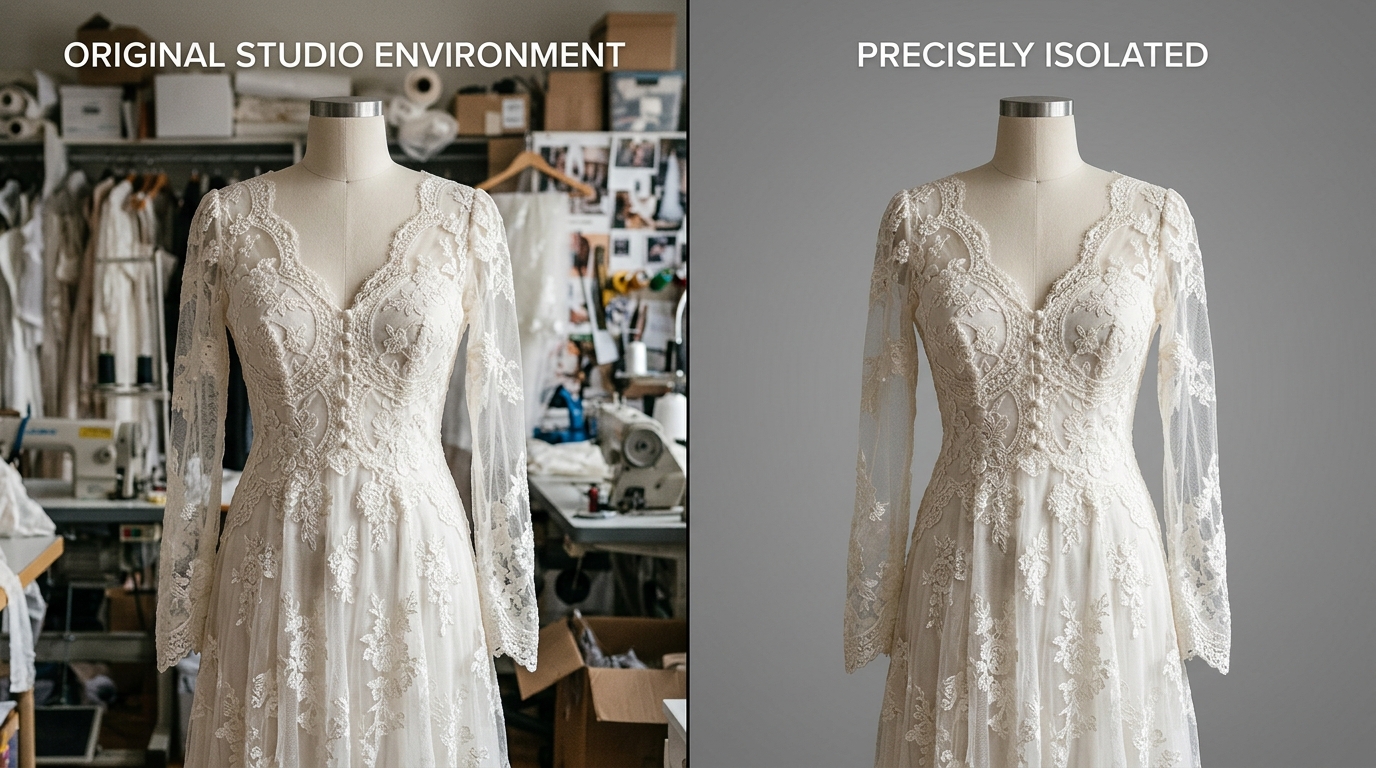
One of the biggest historical challenges in automated background removal has been handling the fine details of fashion products. Items with complex edges, such as hair, fur, lace, or sheer fabrics like organza and chiffon, have traditionally required meticulous manual "clipping paths" created by a human editor in software like Photoshop. This is a time-consuming and expensive process, especially at scale.
Modern AI models are trained on vast datasets of fashion imagery. They learn to identify not just the primary subject but also the nuanced edges and transparencies that define a garment. Using advanced segmentation techniques, these tools can:
Preserve Fine Details: AI can retain individual strands of hair or the delicate edges of a lace dress without the tell-tale "halo" effect of older tools. Handle Transparency: For sheer or semi-transparent fabrics, the AI can retain a degree of opacity, making the product look natural against a new background rather than like a flat cutout. Remove Interior Backgrounds: The AI can intelligently remove the background visible through gaps, such as between a model's arm and torso or through the handle of a handbag.
What is AI background replacement for creating diverse scenes?
Beyond simple removal, the true power of this technology lies in AI background replacement. Once an object is perfectly isolated, it can be placed into any new scene or context. This unlocks significant creative and operational efficiencies for fashion brands. From a single product shot taken in a studio, a brand can generate a multitude of assets for different channels and markets.
This capability directly addresses the need to create relevant, engaging content without the logistical complexity and cost of multiple photoshoots. For example, a single photo of a winter coat can be placed on a snowy mountain background for a marketing campaign, a clean white background for the PDP, and a lifestyle street-style scene for social media.
Asset Type Traditional Method AI-Powered Method
Marketplace Image Separate shoot or extensive retouching to meet compliance (e.g., pure white background). Apply compliant background to existing image in seconds.
Seasonal Campaign On-location photoshoot, costing thousands of dollars and weeks of planning. Place studio model shot into a relevant seasonal environment.
Social Media Post Separate lifestyle shoot or rely on limited user-generated content. Generate dozens of contextual backgrounds to A/B test for engagement.
Are there any tools for achieving consistent backgrounds across an entire fashion catalog?
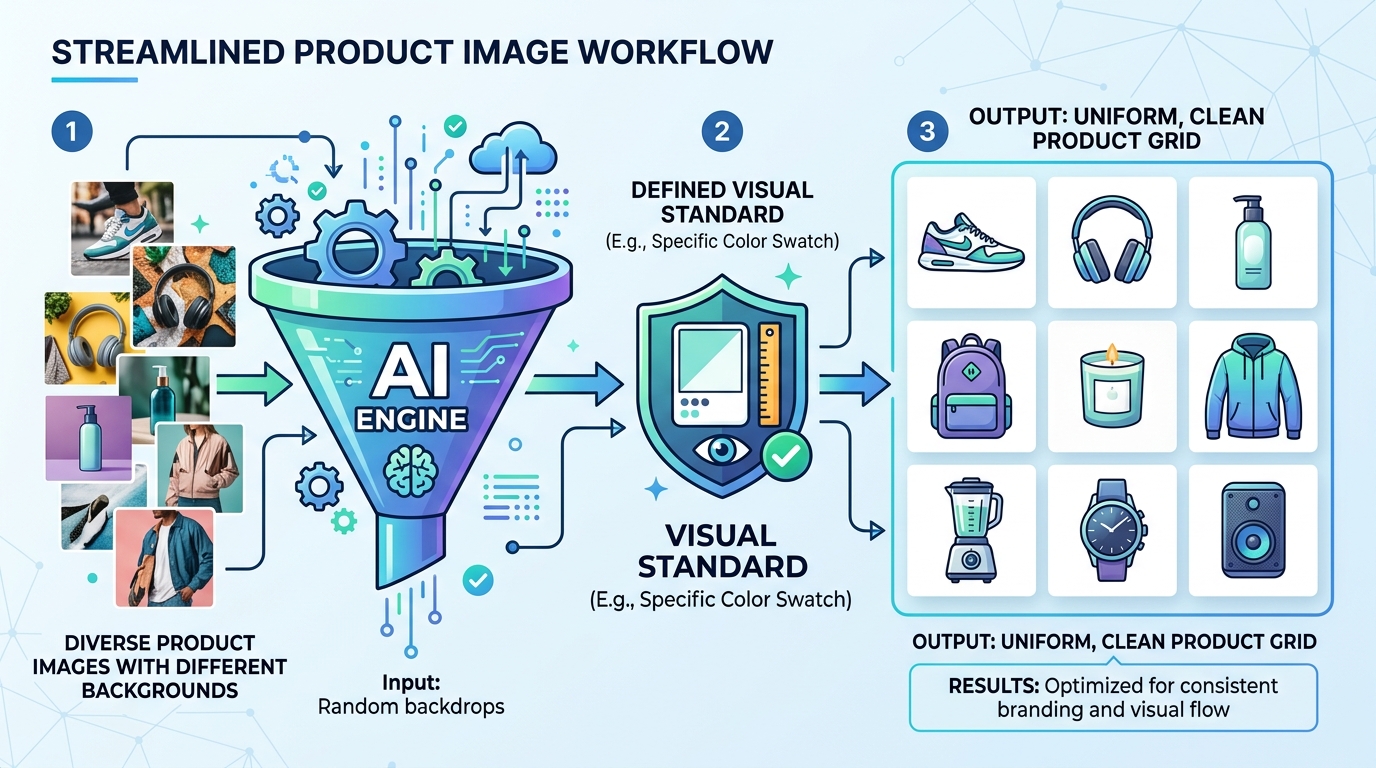
Achieving consistency across thousands of SKUs, shot at different times by different photographers, is a major operational challenge. AI solutions address this by creating a centralized, rules-based workflow. Instead of relying on the subjective judgment of individual retouchers, brands can define a standard—such as a specific hex code for a grey background, a particular shadow style, or a library of approved lifestyle scenes.
This workflow typically involves:
Defining Standards: The brand establishes its visual guidelines for product imagery (e.g., background color #F5F5F5, soft natural shadow). Batch Processing: Entire folders of product images are uploaded to the AI platform. The system automatically removes the existing backgrounds. Applying New Backgrounds: The pre-defined standard background is applied to all images in the batch. Quality Control: A human reviewer or an AI quality check ensures all images meet the set standards before they are finalized.
This automated process ensures that every product image, from a new arrival to a seasonal bestseller, adheres to the same visual identity, creating a cohesive and professional catalog.
Choosing the right AI solution for fashion image background management
When evaluating AI tools for background editing, fashion brands should look beyond basic removal capabilities. The key is finding a solution that understands the specific demands of apparel and accessories and is built for enterprise scale. Key features to consider include:
- Fashion-Specific Training Data: Was the model trained specifically on fashion items, including challenging textures and details? A generic AI may struggle with hair, fur, and sheer fabrics.
- Batch Processing at Scale: Can the system process hundreds or thousands of images at once without a drop in quality or speed?
- API and Workflow Integration: Does the solution offer an API to integrate directly into your existing DAM, PIM, or ecommerce platform? This is critical for automating the workflow.
- Quality and Consistency Controls: Does the platform allow you to set and save specific background colors, shadow styles, and other brand guidelines to be applied consistently across all assets?
FlixStock's visual content platform is designed specifically for these challenges. By combining advanced AI with a deep understanding of fashion retail workflows, it enables brands to generate a full suite of on-brand, market-ready visual assets from a single product input, ensuring consistency and quality at any scale.